Environment & Energy
In reply to the discussion: Climate Scientist James Hansen on, um, Religion. [View all]
NNadir
(38,845 posts)...the isotopic composition of Cs by raising the fraction of 135Cs, not a good thing in my view, particularly how I think fission product cesium should be put to use. I personally believe that the cesium fission product should be more radioactive, not less, and the accumulation of 135Cs because of its long half life reduces the overall radioactivity of bulk fission product cesium. Radioactive cesium because of its remarkable properties can be utilized to solve some intractable environmental problems. We need more of it, not less.
Without any insight to the Copenhagen design, I sincerely doubt that a 1.1 breeding ratio in a thermal spectrum with 233U is possible. Maybe they're trying to claim that removal of 135Xe, allows this, but I'm not sure I buy it.
The value of eta over most of the fission neutron spectrum is modest in 233U , certainly not comparable to 239Pu in the 1-2 MeV neutron energy.
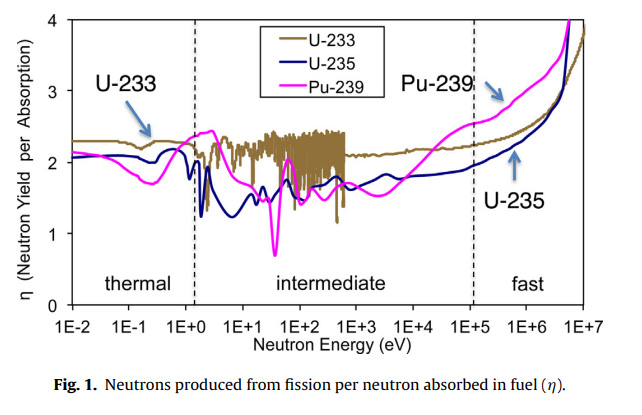
N.R. Brown, J.J. Powers, B. Feng, F. Heidet, N.E. Stauff, G. Zhang, M. Todosow, A. Worrall, J.C. Gehin, T.K. Kim, T.A. Taiwo, Sustainable thorium nuclear fuel cycles: A comparison of intermediate and fast neutron spectrum systems, Nuclear Engineering and Design, Volume 289, 2015, Pages 252-265.
I have never seen an example in the literature where someone claimed a shorter doubling time for any species of 233U comparable to fast plutonium breeding.
I don't happen to have an eta graphic handy and not time to dig one up, but 241Pu is possibly the best breeding fuel of all, far superior in both the epithermal and fast region than either 239Pu, or 233U.
I also don't have a problem with 233Pa in the core if we continuously recycle uranium, something I regard as essential. There is a lot of good reasons to accumulate 234U in nuclear fuel in order to eliminate the need for any kind of enrichment. Believe it or not 234U has a decent fission to capture ratio and can, in fact, reach a critical mass, something 238U cannot do. In the case where it absorbs a neutron rather than inducing fission, the result is 235U.
We absolutely need fast neutron reactors in my view, and I'm working - too slowly I think - on a design I'd like to hand off to my son before I die for a transplutonium burner; americium fuels are only possible in a fast reactor setting. If one looks as the value of eta for americium in fast fission, one is struck by the high neutron yield over most of the neutronic spectrum: In theory, perhaps not in practice the 241Am/242mAm/242 Am system can recover all of the neutrons involved in forming these isotopes. This situation would allow for the accumulation of macroscopic amounts of curium isotopes, a very, very, very good thing in my view.
There are a lot of reactor designs being put forward, which is a good thing. I would never dismiss anyone of them, but some are more hype than others. There have been some pretty dramatic failures even in the design phase; the Transatomic "Waste Free" hype being a rather spectacular example. It was a black eye for MIT's nuclear engineering program as it involved one of their "star" students. I will say that when reading the Transatomic hype, it conflicted with everything I knew, but I accepted it thinking I was missing something.
I suspect that the claims of Copenhagen Atomics may be somewhat oversold. Thorium is an OK nuclear fuel, and I support it, but uranium is better and plutonium from uranium better still.
It is a shame, by the way, that everybody is trapped in sodium or worse sodium/potassium eutectic coolants. I guess they're the devil we know. In a combinatorial optimization sense, it's just a local maximum, certainly not a global maximum. There are other options if we get the materials science right.
As for Copenhagen Atomics, I'll believe it when I see it. Based on your description - and I haven't looked into the details and am relying totally on your description - it vaguely feels like Transatomic.
Edit history
Recommendations
0 members have recommended this reply (displayed in chronological order): = new reply since forum marked as read
Highlight:
NoneDon't highlight anything
5 newestHighlight 5 most recent replies
RecommendedHighlight replies with 5 or more recommendations
= new reply since forum marked as read
Highlight:
NoneDon't highlight anything
5 newestHighlight 5 most recent replies
RecommendedHighlight replies with 5 or more recommendations