Environment & Energy
Related: About this forumClimate Scientist James Hansen on, um, Religion.
Let me preface this by remarking that I am personally an atheist and have a low opinion of cult thinking, although as is ethically required, I respect the right to have a religion, with the caveat that religious people do not have the right to harm other people, which is what the religion to which Hansen refers does. It definitely harms people, killing them actually, since fossil fuel use, um, kills people.
Interestingly, there is some cultists who seem to have a religion about Jim Hansen, as we can see here at E&E, while holding no respect for his views on energy, none at all.
Now, let me be clear on something: This argument, "James Hansen says..." is possibly an example of the logical fallacy called "appeal to authority," which, as described in the link just posted as:
Of course, Dr. Hansen, is not a nuclear engineer, and thus might be considered a "false authority," on nuclear issues, although he has offered in a paper that antinukes and "I'm not an antinuke" antinukes ignore, that I frequently post, that offers supporting data on the death toll associated with antinukism, as evidence for his support for nuclear energy:
Prevented Mortality and Greenhouse Gas Emissions from Historical and Projected Nuclear Power (Pushker A. Kharecha* and James E. Hansen Environ. Sci. Technol., 2013, 47 (9), pp 4889–4895)
It's an old paper, pushing 13 years, during which fossil fuels killed, at the rate of 7 million per year from air pollution according to another source I frequently link: Global burden of 87 risk factors in 204 countries and territories, 1990–2019: a systematic analysis for the Global Burden of Disease Study 2019 (Lancet Volume 396, Issue 10258, 17–23 October 2020, Pages 1223-1249).
Based on the Lancet data, antinukism - which is nothing more than support for fossil fuels - killed about 91 million people since Hansen's paper was published. Hansen now gives a much higher figure for the hourly death rate associated with fossil fuels than the Lancet paper indicates, although he adds water pollution, but whether he has support for that, I'm not sure. He may have misspoke since he is making an oral argument without data before him.
For the record killing 91 million people is the equivalent of killing everyone in that coal dependent antinuke hellhole Germany, and then some.
As for an "Appeal to Authority" claim, it is quite possible, likely, that Hansen doesn't know as much about nuclear engineering as say, I do from years of private study of the issue, or my son, who is a nuclear engineer, does, nor my son's girlfriend, also a nuclear engineer, does, but as someone who does know a great deal about nuclear engineering with a focus on nuclear chemistry, I fully credit his remarks that antinukism is a cult that kills people, even if his numbers in the interview may be off significantly.
The quote comes with a video, which I have not had time to watch, but if one wishes to watch the video, it's at the link.
The link is here: The Green Interview, James Hansen
The quote from the text at the link on nuclear power:
Hansen says that currently the world is getting about 85 percent of its energy from fossil fuels and that putting a price on carbon would allow clean energy alternatives to compete. He argues that nuclear power should be part of the mix that replaces fossil fuels, but he says the anti-nuclear power lobby, a “quasi-religion that opposes nuclear power,” does not have a command of the facts. “Nuclear power has been extremely beneficial in limiting impacts on human health and deaths. For example, the total number of people killed by nuclear power in the history of nuclear power is less than the number of people killed by fossil fuels in the time that’s it’s taking for this interview. In one hour more than 10,000 people die from the effects of fossil fuel pollution, air pollution and water pollution.” Hansen believes that nuclear power could potentially be a significant contributor to clean energy and serve as an alternative base-load electric power but, he says, “It should be the next-generation nuclear power, which solves some of the objections that people have to nuclear power but it has not been allowed to compete.” The U.S. should develop fast reactors that consume nuclear waste and thorium reactors to prevent the creation of new long-lived nuclear waste, he says.
I added the bold, with which I agree.
A correction to another figure put forth by Hansen: According to IEA figures published in the annual World Energy Outlook, the use of fossil fuels in "percent talk" has not changed very much over this century. In the year 2000, it was 80.2%, in 2016, 81.0%, in 2024, 79.4%. In absolute numbers, since energy use is rising not falling, from 420 Exajoules in 2000 to 654 Exajoules in 2024.
In the period between 2000 and 2024, the use of dangerous coal has risen by 81 Exajoules, dangerous petroleum use has risen by 39 Exajoules and the use of dangerous natural gas has risen by 61 Exajoules.
I have almost all of the World Energy Outlooks in my files for this century, and some from the 1990s. I have constructed a table which I post here from time to time from the data in some select years:
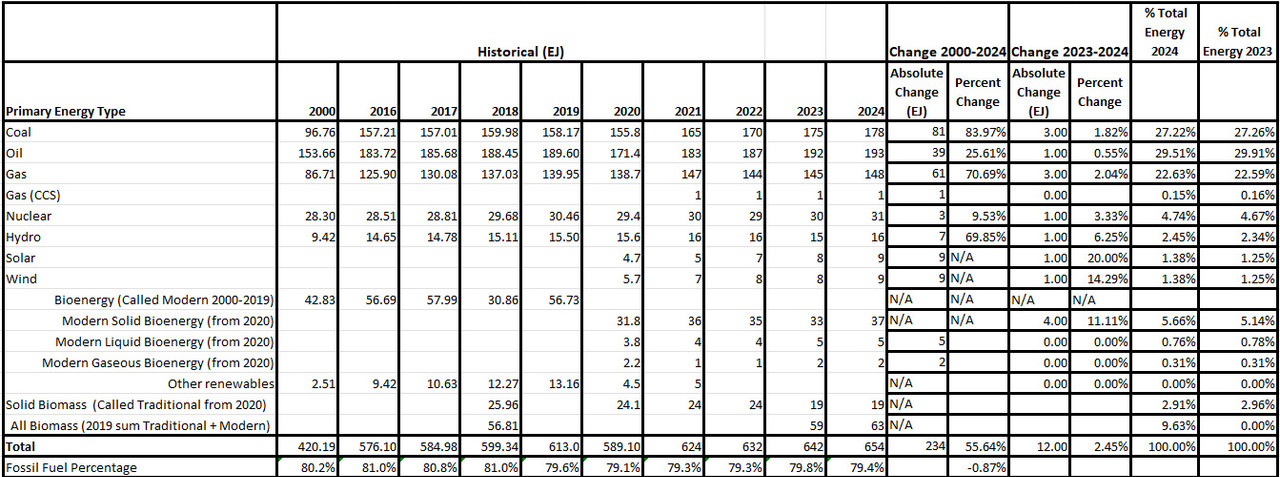
The 2025 data, which I do not expect to be very different from previous years in terms of increases and percentages, will be published in the 2026 WEO, most likely in November.
My corrective comments notwithstanding, I agree that antinukism is a fact free cult, although I do expect members of this antinuke cults, some of whom write here, whose membership is either indifferent to fossil fuels, scientifically illiterate, or badly informed, any one, two or all three, are likely to respond with the usual chanted dogma.
Have a nice day.
 = new reply since forum marked as read
Highlight:
NoneDon't highlight anything
5 newestHighlight 5 most recent replies
= new reply since forum marked as read
Highlight:
NoneDon't highlight anything
5 newestHighlight 5 most recent replies

surfered
(15,004 posts)
NNadir
(38,839 posts)...believe that the collapse of the climate is real and is caused by human activity. It was this one, by John Pershing of Climate Central:
The John Rassweiler Impact Lecture with speaker Climate Central on the 20th Anniversary of D&R Greenway’s Johnson Education Center
It ended up being depressing, because it was all about whether people believe extreme global heating is real, and if they believe it's caused by human activities and so on.
In the Q&A - everyone in the room of course understood that climate change is real and caused by human activity - people were carrying on about solar and wind, and interestingly in a way that was completely contradictory, about maintaining land use.
As the gadfly, I spoke up for nuclear energy and in opposition to so called "renewable energy" by noting that people have been chain sawing Joshua Trees in California, cacti that are 100s of years old with vast root systems that sequester carbon, to install industrial solar plants that will be landfill in 20 to 25 years.
The Climate Central guy after indicating that climate central's role is not to endorse solutions - he went on the remark on something about the antinuke club the Union of Concerned "Scientists" while acknowledging it was just that, an antinuke organization - but rather to get people to understand what's happening.
I pointed out that I monitor the Mauna Loa CO2 regularly and that in 2000 the concentration of the dangerous fossil fuel waste peaked at 372 ppm and that this week we're running at about 432 ppm, and that it's a little late, too late in fact, to be quibbling.
It was, in the end, depressing.
We are indeed, out of time. There are nuclear engineers, my son among them I'm proud to say, who are trying to save what is left to save and can be saved, but every day there is less and less that can be saved.
We're cooked.

OKIsItJustMe
(22,397 posts)James E. Hansen April 11, 2022
New York is to be commended for adopting the Climate Leadership and Community Protection Act, legislation that calls for carbon-free electricity by 2040. However, future generations will judge us by results we achieve, not by our aspirations.
…
Tackling the climate crisis requires policies based on facts, not prejudice. Wind and solar power help with early decarbonization, where they can replace fossil fuels without need for large storage and transmission upgrades. However, systems overly dependent on intermittent, low-energy-density renewables — as California and Germany have proven — lead to skyrocketing electric rates, grid instability, and continued dependence on fossil fuels. Cost-optimized energy modeling reveals that nuclear power must ramp up for emissions to approach zero. In fact, the U.N. Intergovernmental Panel on Climate Change finds that nuclear generation in 2050 grows by two to six times 2010 levels for all four illustrative pathways consistent with limiting global warming to 1.5°C. Today’s policies need to reflect this awareness and initiate multi-decadal plans to achieve reliable, affordable, and sustainable energy systems.
Significantly, many governments are beginning to understand that nuclear power is part of the answer. France, which decarbonized its grid with nuclear years ago, has announced support for a new generation of reactors. So have the United Kingdom, the Netherlands, and Canada. In our country, several states have taken steps to preserve their existing plants, while others like Wyoming are developing passively safe advanced nuclear technology for the future. Members of Congress on both sides of the aisle are on board, too. Highlighting federal enthusiasm, U.S. Energy Secretary Jennifer Granholm recently said, “We are very bullish on advanced nuclear reactors. … Nuclear is dispatchable, clean baseload power, so we want to be able to bring more on.”
New York belongs at the forefront of innovation, not on the sidelines. A brighter tomorrow is possible, but it requires setting politics and ideology aside. If New York is to meet its climate goals while providing ample, reliable energy essential for prosperity, it must engage in an inclusive discussion of solutions and craft a realistic plan that recognizes the value of nuclear power today and in the future.
I agree. Nuclear clearly must be part of the solution.
What does the IPCC say? (Sadly, the Seventh Assesment Report has not been released yet.)
Clarke, L., Y.-M. Wei, A. De La Vega Navarro, A. Garg, A.N. Hahmann, S. Khennas, I.M.L. Azevedo, A. Löschel, A.K. Singh, L. Steg, G. Strbac, K. Wada, 2022: Energy Systems. In IPCC, 2022: Climate Change 2022: Mitigation of Climate Change. Contribution of Working Group III to the Sixth Assessment Report of the Intergovernmental Panel on Climate Change[P.R. Shukla, J. Skea, R. Slade, A. Al Khourdajie, R. van Diemen, D. McCollum, M. Pathak, S. Some, P. Vyas, R. Fradera, M. Belkacemi, A. Hasija, G. Lisboa, S. Luz, J. Malley, (eds.)]. Cambridge University Press, Cambridge, UK and New York, NY, USA. doi: 10.1017/9781009157926.008.
Executive Summary
Warming cannot be limited to well below 2°C without rapid and deep reductions in energy system carbon dioxide (CO₂) and greenhouse gas (GHG) emissions. In scenarios limiting warming to 1.5°C (>50%) with no or limited overshoot (2°C (>67%) with action starting in 2020), net energy system CO₂ emissions (interquartile range) fall by 87–97% (60–79%) in 2050. In 2030, in scenarios limiting warming to 1.5°C (>50%) with no or limited overshoot, net CO₂ and GHG emissions fall by 35–51% and 38–52% respectively. In scenarios limiting warming to 1.5°C (>50%) with no or limited overshoot (2°C (>67%)), net electricity sector CO₂ emissions reach zero globally between 2045 and 2055 (2050 and 2080). ( high confidence) {6.7}
…
Prices have dropped rapidly over the last five years for several key energy system mitigation options, notably solar photovoltaics (PV), wind power, and batteries. From 2015 to 2020, the prices of electricity from PV and wind dropped 56% and 45%, respectively, and battery prices dropped by 64%. Electricity from PV and wind is now cheaper than electricity from fossil sources in many regions, electric vehicles are increasingly competitive with internal combustion engines, and large-scale battery storage on electricity grids is increasingly viable. ( high confidence) {6.3, 6.4}
Global wind and solar PV capacity and generation have increased rapidly. Solar PV grew by 170% (to 680 TWh); wind grew by 70% (to 1420 TWh) from 2015 to 2019. Policy, societal pressure to limit fossil generation, low interest rates, and cost reductions have all driven wind and solar PV deployment. Solar PV and wind together accounted for 21% of total low-carbon electricity generation and 8% of total electricity generation in 2019. Nuclear generation grew 9% between 2015 and 2019 and accounted for 10% of total generation in 2019 (2790 TWh); hydroelectric power grew by 10% and accounted for 16% (4290 TWh) of total generation. In total,low- and zero-carbon electricity generation technologies produced 37% of global electricity in 2019. ( high confidence) {6.3, 6.4}
…
Multiple energy supply options are available to reduce emissions over the next decade. Nuclear power and hydropower are already established technologies. Solar PV and wind are now cheaper than fossil-generated electricity in many locations. Bioenergy accounts for about a tenth of global primary energy. Carbon capture is widely used in the oil and gas industry, with early applications in electricity production and biofuels. It will not be possible to widely deploy all of these and other options without efforts to address the geophysical, environmental-ecological, economic, technological, socio-cultural, and institutional factors that can facilitate or hinder their implementation. ( high confidence) {6.4}
…
NNadir
(38,839 posts)...and minerals squandered on it.
If Dr. Hansen or anyone wants to claim that solar and wind are "cheap" they are ignoring the cost of redundancy, generally provided by fossil fuels, although there are plenty of human slaves in Africa to dig cobalt for batteries and copper to wire all this useless shit together.
I pointed to the excellent paper by Dr. Robert Idel blowing this "cheap" nonsense up:
LFSCOE: The True Cost of Solar and Wind Energy in Texas and Germany in Answer to the Question...
I agree with Dr. Hansen however that the need for large storage is pernicious. It is also unnecessary, since nuclear power plants can do something that land intensive and mineral intensive solar and wind junk can't do: Run continuously, day and night, without interruption.
Of course the real point of the OP is that I agree with him that antinukism is a quasi-religious cult. I might have slight reservations as to whether Dr. Hansen's prefix "quasi" actually applies and I've suggested in the OP places where, despite his strong support for nuclear energy, he may be mistaken on particulars with data.
But, again, I certainly agree emphatically antinukism is a cult.
A member of this cult, I've actually observed, attempted to imply that the World Nuclear Association is antinuclear the other day.
One hears these sorts of things, and one doesn't want to believe that one is hearing them.
This led to an exchange about "straw men" which I found to be appropriate, noting that I admired the strawman in the Wizard of Oz played by Ray Bolger in the movie, wanted to have a brain. Other strawmen in my experience seem to be uninterested in having brains.
The interview with Dr. Hansen in the OP took place in March of 2017. The average concentration of the dangerous fossil fuel waste carbon dioxide as reported at the Mauna Loa CO2 Observatory was 407.18 ppm. On April 29 of this year it was 432.48 ppm.
We're doing just great!!!!!
From 2018-2025, the investment in so called "renewable energy" was 4.563 trillion dollars.
What do we have to show for it?
I did watch a bit of the interview, wherein Dr. Hansen argued strongly against "received wisdom," as well as the inability to question one's self. I'm quite sure, as a good scientist, he would not regard himself as oracular, although there seem to be people who think he is.
I agree with him on many, most things, but I also feel quite ready to disagree with him as well, which I do if he claims that solar and wind junk is useful. It isn't.
There was a time, even in my early days at DU back in the early 2000's where I supported the idea that solar and wind had value. I am, after all, a good Democrat and that was part of our party line. This said, I've come to think of it as our answer to creationism. So called "renewable energy" doesn't work to reduce fossil fuel use. It entrenches fossil fuels. After the expenditure of trillions of dollars on that junk, none of which went to ameliorate the lives of the de facto slaves described in the Elements of Power, and after careful extensive work reviewing the geology of materials, issues in land use, and the huge environmental and material costs of connecting all this rickety shit together, I've changed my mind based on careful analysis of the data. There isn't enough copper on Earth to get solar and wind to the 148 Exajoules of energy that dangerous natural gas produced in 2024, never mind the 178 Exajoules produced by dangerous coal and the 193 Exajoules produced by dangerous petroleum.
The process of coming to this conclusion came from a conversation I had with the nuclear activist Rod Adams in his home many years ago.
Solar and wind to my mind are useless bourgeois affectations that is the province of the antinuke and "I'm not an antinuke" antinuke cults I observe here and elsewhere.
I think them to be absurd and clueless.
I am quite secure in asserting that nuclear energy is the only form of sustainable energy. The sooner this becomes recognized throughout the world, the better chance we'll have to save anything left to save, stuff that is left to save diminishing daily. No amount of strawman/scarecrow whining can change my mind in respect to this view, although I am proud to say, I have a long history of being able to change my mind, something with which antinukes and "I'm not an antinuke" antinukes clearly struggle.
Have a nice day.
OKIsItJustMe
(22,397 posts)Your obstinate “Nothing but Nukes” approach would be just as bad as a “No Nukes” approach. It would be “a day late and a dollar short.” (Nuclear power is notoriously behind schedule and over budget.)
Most countries agree that nuclear power must be part of any solution, but, are deploying renewables as quickly as possible.
Once again, please stop misrepresenting Hansen’s views, and mine as well. — However history has shown that you will do neither.

thought crime
(1,832 posts)I haven't seen many posts here actually advocating for a complete ban on nuclear energy or for the exclusive use of renewable energy. So where are all these "anti-nuke" people? Germany? Could they possibly be imaginary? OTOH I have seen plenty of posts here that claim nuclear energy is the only thing that can possibly save us, that renewable energy is a disaster, etc. In fact, there seem to be so few real outright "anti-nukes" that the Nuclear Brothers must resort to referring to renewable energy fans as " 'I'm not an anti-nuke' anti-nukes". It seems desperate and really kind of paranoid.
I don't usually give nuclear energy much thought; it seems kind of static. If nuclear energy is strictly regulated and if nuclear waste is managed safely, I think we can continue using it for some time. That's just my default opinion. But after reading way too many of these anti-renewable attacks by the local Nuclear Brothers and raising my awareness (thanks for that, by the way), I think I may be at risk of becoming an "I'm not an 'I'm not an anti-nuke' anti-nuke". Yeah, I'll cop to that.
NNadir
(38,839 posts)When I drive my hybrid car, or use my lithium battery powered lawnmower and then sit down in my home to read this book...
The Elements of Power
Subtitle:
...which is about the horror of cobalt and copper slavery in Katanga in the Congo, the child slaves, etc., and I want to know who is responsible for this moral, economic and environmental tragedy, this device works quite well to identify a culprit.
Have a nice day.
thought crime
(1,832 posts)It is important to note that James Hansen is primarily a climate scientist and his "authority" is based more on his understanding of the problem of climate change and its causes than on his expertise or ability to suggest a solution.
Here’s the money quote from a very recent article by James Hansen:
https://jimehansen.substack.com/p/politics
He seems to understand the transition to clean energy will take some time. Any safe technology that reduces the output of carbon should be welcomed by anyone concerned about the danger of fossil fuels.
NNadir
(38,839 posts)Last edited Sat May 2, 2026, 07:39 AM - Edit history (1)
..."renewable energy" which has had no effect on climate, entrenches the use of fossil fuels, destroys pristine wilderness - an important carbon sink - and robs future generations of the best ores.
OKIsItJustMe
(22,397 posts)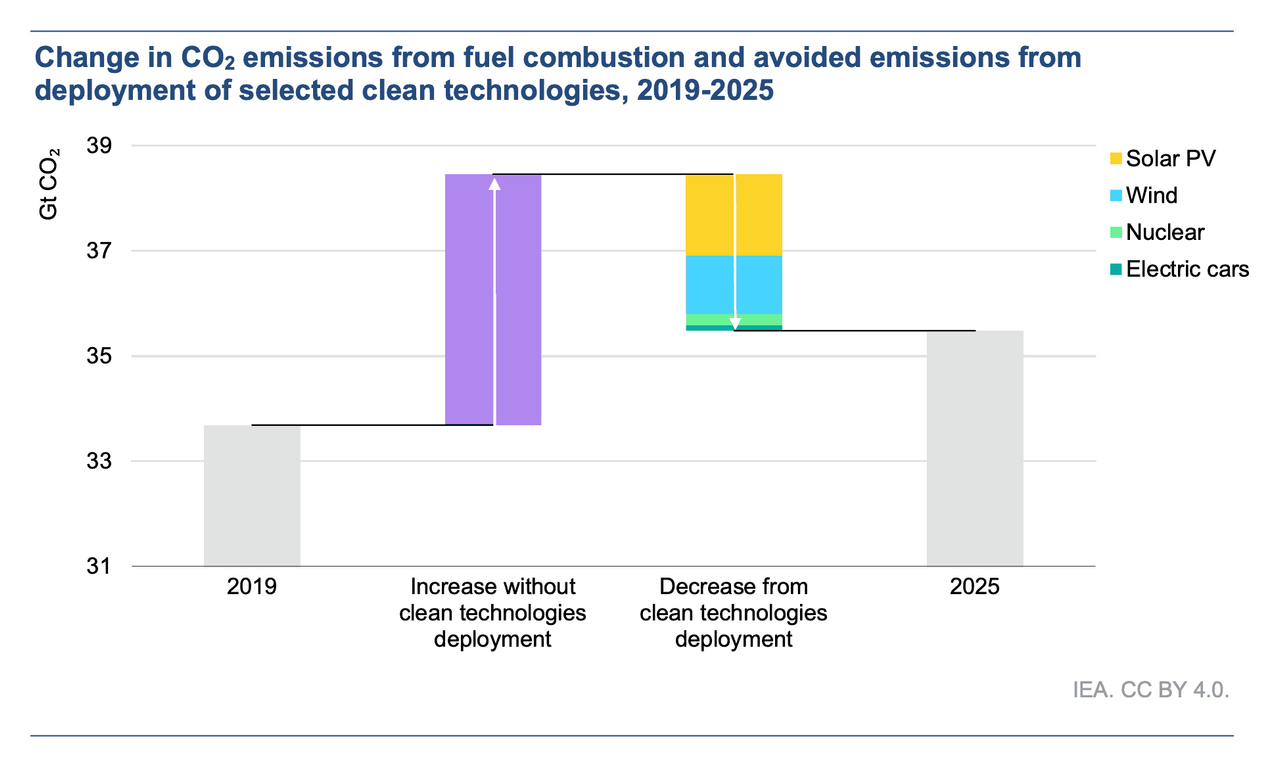
Together, solar PV, wind power, nuclear power, electric cars and heat pumps avoided around 3 Gt of CO₂ emissions in 2025, equivalent to around 8% of global energy-related CO₂ emissions annually. In some markets, the impact has been even more pronounced. In China, the European Union, Australia, New Zealand and Brazil, the deployment of these technologies since 2019 avoided the equivalent of more than 10% of energy-related CO₂ emissions in 2025.
Globally, the rollout of solar PV made the largest contribution, avoiding 1.5 Gt of annual CO₂ emissions, equivalent to around half of India’s total annual CO₂ emissions in 2025. Half of the emissions avoided by solar PV were in China. Avoided emissions from deployment of wind power amounted to 1.1 Gt of CO₂, equivalent to the combined annual emissions of France, Germany and Italy. Nuclear power, electric cars and heat pumps followed at 210 Mt, 100 Mt and 90 Mt of CO₂ respectively. While the avoided emissions from electric cars and heat pumps are lower than from the other technologies studied, they may increase in coming years as the stock of these technologies continues to expand.
IEA (2026), Global Energy Review 2026, IEA, Paris https://www.iea.org/reports/global-energy-review-2026, Licence: CC BY 4.0
Dr Hansen has been sidelined a bit over the last decade; he estimates the warming from a doubling of CO2 levels to be considerably higher than the IPCC consensus, and claims that the countervailing human-caused cooling, from coal particulates and sulfur dioxide in ship stack exhausts, has masked this warming effect. I think his loss of airtime partly relates to his support for nuclear; more 'PC' pundits like Michael Mann, the 'hockey stick' originator, argue that renewables are doing the job, and temperatures will stabilise (though not go down) as soon as we get to nett zero. Naomi Oreskes (author of 'Merchants of Doubt' about the oil-funded climate contrarian campaign) even called Hansen a type of 'denier' for not worshipping at the altar of wind and solar. Unfortunately for them, and us, it's looking like Hansen was right again. 2024 was called an outlier, with world temperatures predicted to fall again afterwards, to a gentler slope on the graph. Instead 2025 stayed nearly as hot, and 2026 could be worse. The reduction in sulfur pollution over the northern Pacific and Atlantic, as high sulfur marine bunker oil was outlawed, is acknowledged to be a factor, though how big a factor is disputed.
I've just been reading 'The Story of CO2 is the Story of Everything', by Peter Brannen (after hearing him interviewed on Dr Chris Keefer's 'Decouple' podcast.) That widens the stage by a few billion years. Advanced life was only possible from 600 million years ago, after so much carbon had been locked underground that a free-oxygen atmosphere was possible. Homo sapiens is trying to reverse that imbalance, at a faster rate than in any of the five great extinctions. However, I don't think pessimism is either useful or justified. Sure, us humans do some very dumb things, but we also have a lot of very smart people. The SO2 aerosols we were emitting may have been cutting our warming effect by 40%; Hansen in his earliest climate projection even included a volcanic cooling remarkably similar to the early 90's Pinatubo effect. We can do the same, but strategically, without the associated lung disease and acid rain from coal and bunker oil. The whales we slaughtered en masse were fertilising the oceans with iron from deep water, that caused carbon-sequestering blooms of diatoms. By putting about an eyelash's mass of iron per cubic metre in the downwash swirls of the Gulf Stream, the Kuro Shiyo current, the Agulhas Current, the Australian Current, and the Brazil Current, we can recreate this major carbon sink, while we wait for the whales to recover.
A tiny Danish company called Copenhagen Atomics claims that by the year 2000, more than half of mankind's energy will come from thorium - from none at all now, and 80% from fossil fuels. That sounds presumptuous, but one little Dutch company makes 100% of the incredibly high-tech machines that make all the world's topline computer chips. Energy delivered 24/7/365, as 100 megawatts of 600C heat, or 40 MW of 2c/kWh power, from 40 foot shipping containers, is an attractive proposition, if they can swing it. Low power fission trial, in a full sized reactor, scheduled next year, in Switzerland.
NNadir
(38,839 posts)...that it's in Denmark, that offshore oil and gas drilling little country that has been antinuke heaven.
I believe there is a role for thorium; it's certainly available from the mine tailings of the lanthanide mining industry that all of our antinukes ignore, much as they ignore the tragedy of cobalt mining, phosphate mining in the Western Sahara and so on...
From my perspective the only sustainable fuel for the length of time that humanity exists is uranium put into a fast spectrum. This is because uranium is slightly soluble in seawater and in ground water (where it is a constituent of NORM, naturally occurring radioactive materials) where health consequences occur. Thorium is by contrast, far less soluble, although the mined thorium dumped by the lanthanide miners might well support humanity for centuries.
From my perspective, the best use of thorium is in a ternary fuel in CANDU type reactors, consisting of reactor grade plutonium, depleted or once through uranium - the latter being slightly preferable owing to the presence of 236U which does not occur naturally on Earth anymore - and thorium. This converts heavy water reactors of the CANDU type into breeder reactors that will capture the value of 236U as well as making the uranium in used fuel, "pre-enriched" after removal of neutron absorbing fission products, via the generation of 233U, 234U and 235U.
Thorium is, in my view, subject to a fair bit of over enthusiastic hype. We need to put the vast amount of uranium, mostly now depleted already mined to use. This requires the fast spectrum, or, more slowly in terms of doubling time, the fuels described in the previous paragraph.
If I have a chance I may write a brief post here on another of the thousands of papers on uranium adsorption that came up recently, mixing nanotechnology and amidoxime resins, from a recent issue of Industrial Engineering and Chemistry Research. We don't actually need to obtain uranium this way for the time being, but it will clean up NORM impacted ground water, and in some cases, river water, as well as agricultural run off contaminated by uranium carried from phosphate ores.
As for James Hansen, he's a very old man who has done his share. He's exhausted, I'm sure, and deeply pessimistic about the future of humanity as he has every right to be. His efforts on behalf of humanity in supporting nuclear energy will stand up well in history, should humanity survive the use of fossil fuels, about which antinukes couldn't care less.

John ONeill
(95 posts)The ANEEL fuel intended to burn thorium in Candus needs HALEU at 12 to 20% fissile as a starter for each fuel bundle (or equivalent concentration of plutonium), and will not be a true breeder, with conversion ratios below 1.0. CopAtomx should get much better neutron economy even than a Candu -
1/ there's no xenon 135 in the core, it's rapidly outgassed from the salt, just from vapour pressure, at 700 C
2/ Unlike with an ANEEL fuel bundle, there's no high neutron cross section protactinium in the core (it's all in the blanket, and with the thorium to protactinium ratio there at about 1000 to one, parasitic neutron losses should be low)
3/ the spherical core geometry, with heavy water inside and around it, and a breeding blanket round that, minimises leakage.
CA claim they can breed with 5% LEU (or equivalent in transuranics), at about 1.1 breeding ratio once they fully convert to U233, and so grow more quickly than a fast reactor fleet. If they fail, there are plenty of fast neutron contenders - Russia's BREST 300 and BN1200, Newcleo in France and Italy, Terrapower's Natrium in Wyoming, Blykalla in Sweden - but thermal spectrum reactors so far have had a better operational record. Maybe even Japan's reduced moderation boiling water concept could breed ... but nobody's working on that, CA have hardware nearly ready for low power fission testing.
NNadir
(38,839 posts)...the isotopic composition of Cs by raising the fraction of 135Cs, not a good thing in my view, particularly how I think fission product cesium should be put to use. I personally believe that the cesium fission product should be more radioactive, not less, and the accumulation of 135Cs because of its long half life reduces the overall radioactivity of bulk fission product cesium. Radioactive cesium because of its remarkable properties can be utilized to solve some intractable environmental problems. We need more of it, not less.
Without any insight to the Copenhagen design, I sincerely doubt that a 1.1 breeding ratio in a thermal spectrum with 233U is possible. Maybe they're trying to claim that removal of 135Xe, allows this, but I'm not sure I buy it.
The value of eta over most of the fission neutron spectrum is modest in 233U , certainly not comparable to 239Pu in the 1-2 MeV neutron energy.
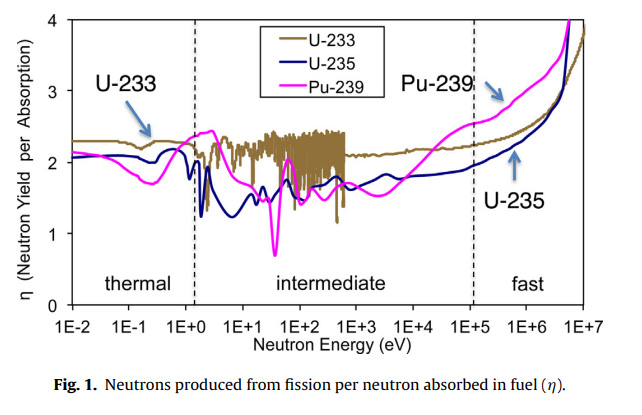
N.R. Brown, J.J. Powers, B. Feng, F. Heidet, N.E. Stauff, G. Zhang, M. Todosow, A. Worrall, J.C. Gehin, T.K. Kim, T.A. Taiwo, Sustainable thorium nuclear fuel cycles: A comparison of intermediate and fast neutron spectrum systems, Nuclear Engineering and Design, Volume 289, 2015, Pages 252-265.
I have never seen an example in the literature where someone claimed a shorter doubling time for any species of 233U comparable to fast plutonium breeding.
I don't happen to have an eta graphic handy and not time to dig one up, but 241Pu is possibly the best breeding fuel of all, far superior in both the epithermal and fast region than either 239Pu, or 233U.
I also don't have a problem with 233Pa in the core if we continuously recycle uranium, something I regard as essential. There is a lot of good reasons to accumulate 234U in nuclear fuel in order to eliminate the need for any kind of enrichment. Believe it or not 234U has a decent fission to capture ratio and can, in fact, reach a critical mass, something 238U cannot do. In the case where it absorbs a neutron rather than inducing fission, the result is 235U.
We absolutely need fast neutron reactors in my view, and I'm working - too slowly I think - on a design I'd like to hand off to my son before I die for a transplutonium burner; americium fuels are only possible in a fast reactor setting. If one looks as the value of eta for americium in fast fission, one is struck by the high neutron yield over most of the neutronic spectrum: In theory, perhaps not in practice the 241Am/242mAm/242 Am system can recover all of the neutrons involved in forming these isotopes. This situation would allow for the accumulation of macroscopic amounts of curium isotopes, a very, very, very good thing in my view.
There are a lot of reactor designs being put forward, which is a good thing. I would never dismiss anyone of them, but some are more hype than others. There have been some pretty dramatic failures even in the design phase; the Transatomic "Waste Free" hype being a rather spectacular example. It was a black eye for MIT's nuclear engineering program as it involved one of their "star" students. I will say that when reading the Transatomic hype, it conflicted with everything I knew, but I accepted it thinking I was missing something.
I suspect that the claims of Copenhagen Atomics may be somewhat oversold. Thorium is an OK nuclear fuel, and I support it, but uranium is better and plutonium from uranium better still.
It is a shame, by the way, that everybody is trapped in sodium or worse sodium/potassium eutectic coolants. I guess they're the devil we know. In a combinatorial optimization sense, it's just a local maximum, certainly not a global maximum. There are other options if we get the materials science right.
As for Copenhagen Atomics, I'll believe it when I see it. Based on your description - and I haven't looked into the details and am relying totally on your description - it vaguely feels like Transatomic.
John ONeill
(95 posts)... is indeed a cautionary tale. At least CA isn't proposing an untried moderator, and they have two chemical engineers among the four founders - one of them was mentored by a Danish professor who'd worked at Oak Ridge when the Molten Salt Reactor Experiment was under way. Cast your bread upon the waters ...
Their low power fission trial in Switzerland next year should clarify things. The company's already the world's largest purchaser of thorium, so I guess they believe their own hype.
NNadir
(38,839 posts)...separation on an MSR from what I see from a quick glance.
Concern about tritium generation has always been a concern on FLIBE based systems. (I'd be more concerned about beryllium but that's just me.)
Actually 6Li would supply an excellent source of helium, both isotopes as the tritium decays into valuable 3He.
It looks as if they're focusing on modest improvements in neutron economy but I can't imagine they'd see a 1.1 breeding ratio. The best I've ever heard of was 1.03 with 233U.
Years ago I was a FLIBE kind of guy, but those days are over.
If they go under the thorium they buy will be a fungible asset for creditors to sell. I would love to hear of the Canadians buying it, along with some of the plutonium lying around in other places.
jfz9580m
(17,910 posts)
hunter
(40,937 posts)... but now that we've actually done the experiment at very large scales it's clearly a dead end, possibly for civilization itself.
The comparison to religion is apt. When people have been taught their entire lives that renewable energy will save the world they dismiss all the evidence that it cannot and may get angry at the people who are actually doing the math.
Evolutionary biology is one of my personal interests and I have some formal training. It was the focus of my undergraduate studies. I've done the math, I've done the field work, I keep current with the science. Sometimes I have some crazy ideas about the topic but I'm well aware of my shortcomings. It doesn't hurt me to have these ideas disproved. I learn something new.
In my experience arguing with the "true believers" of renewable energy is much like arguing with Evangelical Christian Creationists. Their faith is unwavering. Some of them may be opportunists, much like the television and megachurch pastors, but I think most have simply embraced the idea that there's some renewable energy utopia just over the horizon.
Well, here we are over the horizon. Vast areas are covered with solar panels and giant wind turbines. Batteries and solid state power handling systems that would astonish any time traveler from the 'seventies distribute the energy these systems harvest.
Alas, the numbers are in and it's not enough. Renewable energy will not displace fossil fuels. Renewable energy will not save the world, nor will it significantly delay some of the horrors to come.
One can direct renewable energy evangelists to sites compiling real world performance data, even walk them through the math, but it changes nothing. They remain ever hopeful. Frankly I think it's just an alternative sort of climate change denial.
NNadir
(38,839 posts)The reason was that most people lived short miserable lives of dire poverty.
hunter
(40,937 posts)People could be optimistic about gigawatt scale wind and solar projects, possible synergies, and "smart grids" because nobody had any experience operating such systems.
Now we do.
NNadir
(38,839 posts)I also at one time thought that a reactor failure would kill millions of people. Then one failed in the worst way possible, at Chornobyl. Chornobyl launched my interest in nuclear energy and brought me to where I am today, in a way I certainly didn't expect.
While I had always thought of myself as an "environmentalist," Al Gore's campaign for the Presidency and his effort to popularize the issue of what was then called, rather euphemistically, "climate change," coalesced the work that led to my current thinking.
Thinking about Al Gore and his recommended "solutions" coupled with my understanding of Carter era policies, particularly his focus on Fischer Tropsch coal to oil, caused me to understand the severe limitations of "appeal to authority" arguments.
I voted for Carter twice and Gore three times, two as VP and one as President. I think Gore, in particular would have prevented the political collapse of the United States, the destruction of its Constitution now well underway. Gore's work as VP to secure Russian weapons grade uranium to blend down to LEU was inspiring and wise.
Overall however his strong belief in so called "renewable energy" which I shared at the time, has proved to be a disaster when put into action, but nowhere near as bad as Carter's FT coal to oil if put into practice would have been.
We would not have had Reagen and Bush one had Carter not been so obsessed with oil as to embrace the Shah of Iran. That made a mockery of his stated belief in human rights, because SAVAK was a criminal organization.
Reagan of course was a worse disaster, but the beliefs of the 1970s set us on a course to where we are today, a dying country on a dying planet.
We can say that both Carter and Gore were in a sense, scientific, inasmuch as they were willing to have theories to be tested by experiment, but both experiments have failed in the sense the hypotheses about how to address energy issues were disproved by those experiments, here and elsewhere, notably in Germany..
At least Dubya put solar cells on his ranch, although it didn't do shit for the environment, because solar hasn't done shit for the environment anywhere other than to make it worse.
I cannot believe that at the end of my life, things have fallen this far. The things I believed as a young man were part of the problem. I was wrong to buy into so called "renewable energy."
I will say had Gore become President, he might have prevented the fall of the United States, as would have the election of Hilliary Clinton. I think she would have been a better President than her husband was and overall he did a pretty good job. Of all the Democratic candidates of my lifetime, she was, I think, the best to not accede to the office.
Obama though was the best President of my lifetime. His appointment of Steven Chu to be Secretary of Energy was inspired. Chu understood the value of nuclear energy, righting the course of our party with respect to nuclear issues now well underway but hardly complete.
OKIsItJustMe
(22,397 posts)Since the 1970’s the efficiency of PV panels has skyrocketed, while their cost have plummeted. However, the intermittency of solar and wind represents a tremendous challenge. That’s why most experts look to a hybrid power system, predominantly renewables, supported by nuclear power (of some sort.)
(Please note: The following content is taken from a Creative Commons source.)
IEA (2025), World Energy Outlook 2025, IEA, Paris https://www.iea.org/reports/world-energy-outlook-2025, Licence: CC BY 4.0 (report); CC BY NC SA 4.0 (Annex A)
The NZE Scenario illustrates a possible global path to the goal of net zero emissions by 2050. Each country will have its own pathway, depending on their circumstances. The energy transition set out in the NZE Scenario has four main pillars: deployment of low-emissions sources of electricity and electrification to reduce emissions in end-uses; improvements in energy efficiency; use of low-emissions fuels such as hydrogen, biofuels, and CCUS; and reductions in methane emissions. These strategies rapidly reduce emissions and drive a demand-led transition away from fossil fuels in this scenario.
7.3.1 Clean electrification
Today, the power sector accounts for about 40% of global energy-related emissions. Shifting electricity generation to low-emissions sources and increasing the deployment of lowemissions electricity in existing and new end-uses are central to the NZE Scenario: these strategies give rise to around two-thirds of the emissions reductions to 2035 (Figure 7.12). In the NZE Scenario, low-emissions sources provide nearly all electricity generation by 2040, while electricity increases its share in total final consumption to around 40% by 2040 and 55% by 2050. The expanding role of electricity in total final consumption and the increase in electricity supply from variable renewable sources underline the importance of electricity security in the NZE Scenario.
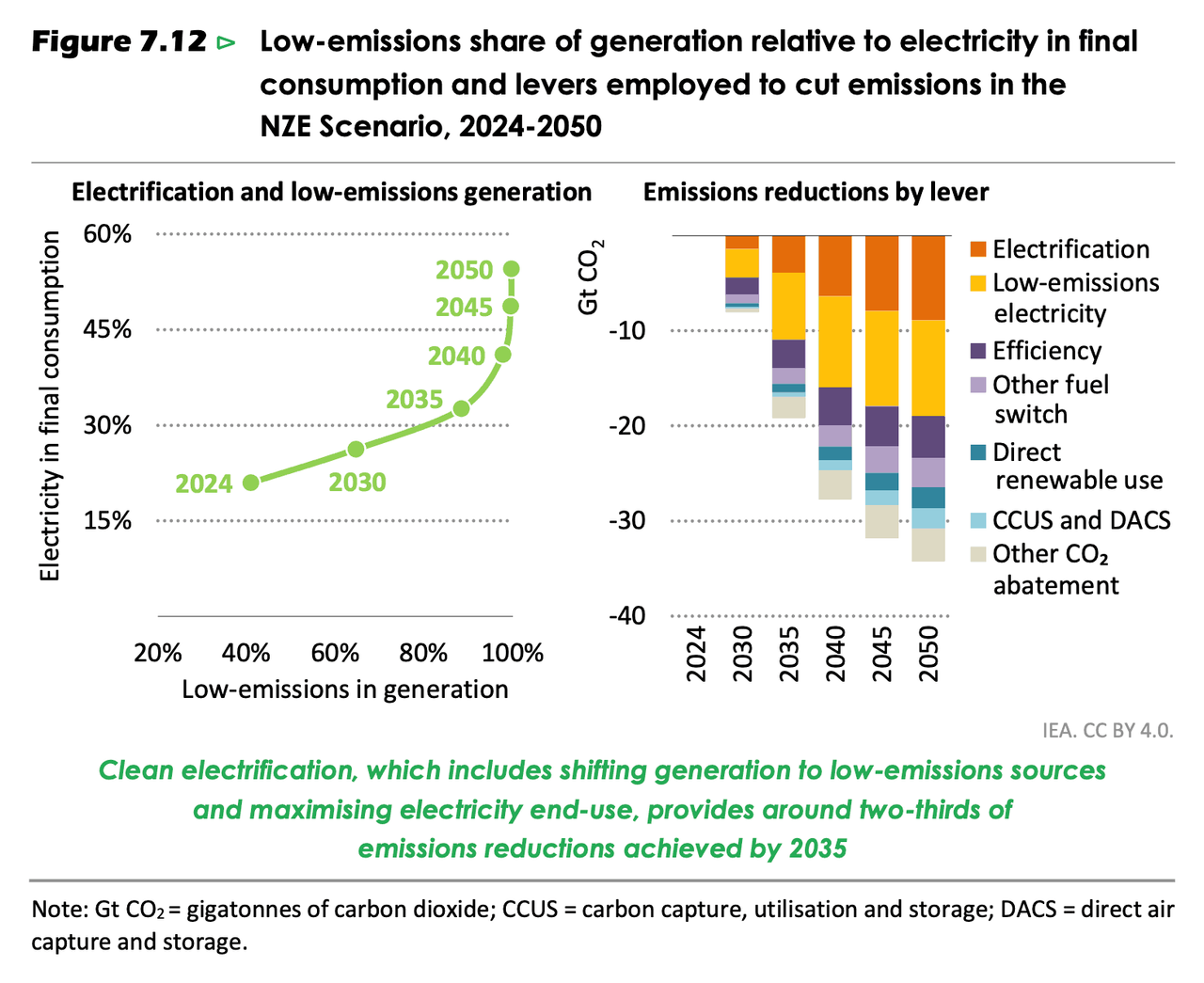
Generating electricity with low-emissions sources
Low-emissions sources of electricity – renewables, nuclear, fossil fuels with CCUS, hydrogen and ammonia – accounted for just over 40% of global electricity generation in 2024, up from around 30% a decade ago. Renewables were responsible for 32% of power generation worldwide, and nuclear for around 9%: there was also a very small contribution of less than 0.003% from fossil fuels equipped with CCUS.
Global installed capacity of renewables triples to 2030 from a 2022 baseline in the NZE Scenario, building on the strong momentum already seen in the power sector, and meeting the goal set at COP28 in 2023 (Figure 7.13). As a result, renewables expand from around one-third of total generation today to around three-quarters by 2035. Achieving this while maintaining electricity security means ensuring that investment in electricity system flexibility keeps pace. Having surged by over 80% in 2024, the installed capacity of stationary batteries increases 17-fold to 2035, average of 30% per year, reaching almost 2 900 gigawatts (GW) in capacity terms and more than 8 400 gigawatt-hours (GWh) in energy terms. In the NZE Scenario, investment surges in grid infrastructure, and around 30 million kilometres (km) of new transmission and distribution lines are added by 2035.
As variable renewables such as solar PV and wind account for a rising share of generation, dispatchable capacity plays a critical role to ensure electricity security. Long lead-times for nuclear limits its role in the near term, but installed nuclear capacity in the NZE Scenario increases 70% by 2035 from the current level, and by 2050 it is two-and-a-half times higher. By the 2030s, the nuclear industry delivers annual additions of around 40 GW per year (Box 7.3). Hydropower capacity also expands strongly, with generation increasing more than 1.5-times by 2050. Unabated fossil fuel plants are operated increasingly for flexibility and capacity adequacy, and consequently their installed capacity falls more slowly than their output across the Outlook period. Fossil fuel plants equipped with CCUS and plants fired with hydrogen or ammonia are also deployed, providing additional low-emissions dispatchable capacity.
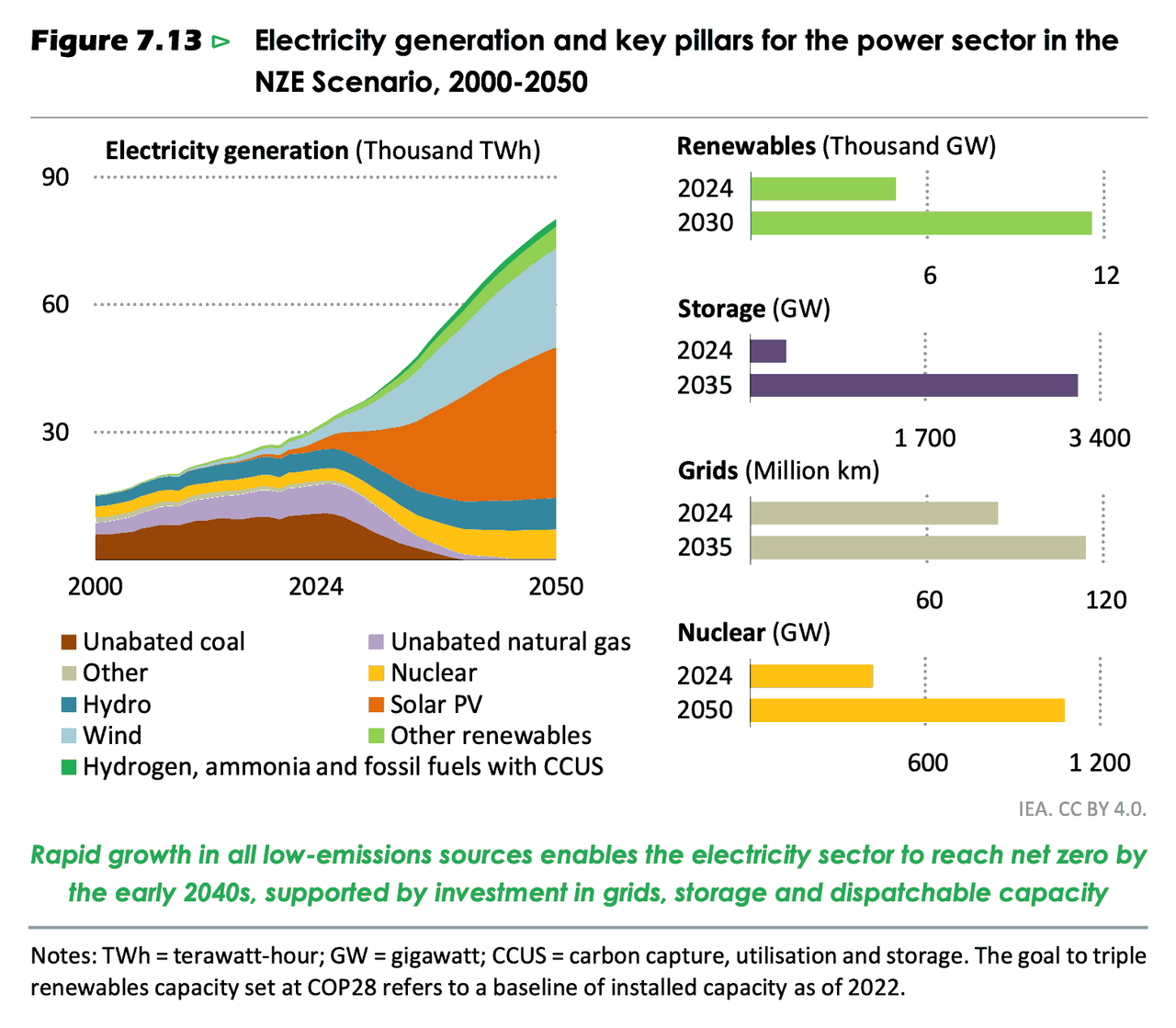
IEA (2025), World Energy Outlook 2025, IEA, Paris https://www.iea.org/reports/world-energy-outlook-2025, Licence: CC BY 4.0 (report); CC BY NC SA 4.0 (Annex A)
thought crime
(1,832 posts)If you want to do the math, count up the world's reserves of solar and wind energy. It's a pretty big number.
Nuclear bros just slay me. They can go ahead and wallow in pessimistic and petty tech-bigotry. They can worship at the altar of the Nuclear Fuel. Tilt at windmills. But that's not a cult out there developing renewable energy; it's some pretty big companies and governments. It's China, UK, Japan, France (yep, France), Korea, etc. etc. etc. etc. It's engineers and market analysts, helping policymakers reach climate goals. If the Nuclear Brothers want to remain in denial they can go ahead. It might be more comfortable in the US, a remaining bastion of climate denial, where they can align with Trump in his war on renewables, and his embrace of nuclear energy. Strange Bedfellows? Just a coincidence? Is it impolite to ask, "Whose side are they on"?