Author Vanessa Lloyd
Posted on February 9, 2023 4:37 pm
With the success of NASA’s Artemis I launch, the previously unexplored shadowy regions near the lunar South Pole where Artemis astronauts will land in 2025, are more within our reach than ever before.
One instrument that will support these future lunar exploration efforts is a hypersensitive optical camera called ShadowCam. ShadowCam is one of six instruments on board the Korea Aerospace Research Institute (KARI)’s Korea Pathfinder Lunar Orbiter, known as Danuri, which launched in August 2022 and entered lunar orbit last December.
Previous cameras in lunar orbit were designed to acquire images of sunlit surfaces. Developed by Malin Space Science Systems and Arizona State University, ShadowCam’s primary function is to collect images within permanently shadowed regions near the lunar poles. These areas never receive direct sunlight and are thought to contain water ice – a significant resource for exploration that can be used as fuel or oxygen and for other habitation applications.
Building on cameras developed for NASA’s Lunar Reconnaissance Orbiter, ShadowCam is 200 times more light-sensitive and is therefore able to capture detailed images within permanently shadowed regions – even in the absence of direct light – by using the light that is reflected off nearby geologic features such as mountains or the walls of craters.
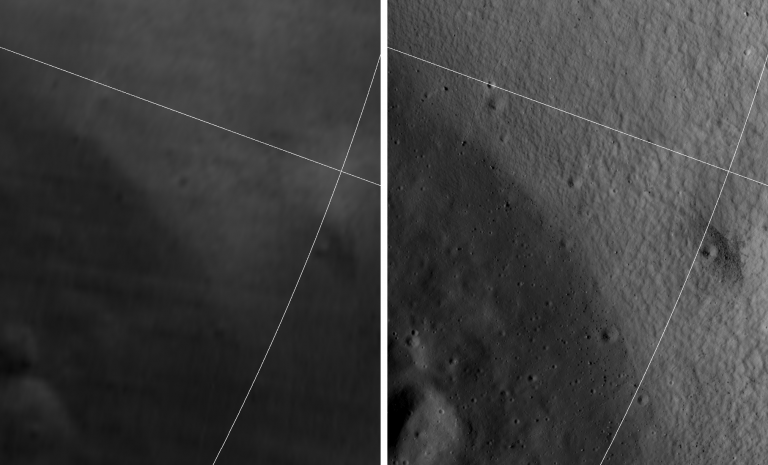
Images of the permanently shadowed wall and floor of Shackleton Crater captured by Lunar Reconnaissance Orbiter Camera (LROC) (left) and ShadowCam (right). Each panel shows an area that is 5,906 feet (1,800 meters) wide and 7,218 feet (2,200 meters) tall. Image Credit: NASA/KARI/ASU
More:
https://blogs.nasa.gov/artemis/2023/02/09/nasas-shadowcam-images-permanently-shadowed-regions-from-lunar-orbit/

 = new reply since forum marked as read