Welcome to DU!
The truly grassroots left-of-center political community where regular people, not algorithms, drive the discussions and set the standards.
Join the community:
Create a free account
Support DU (and get rid of ads!):
Become a Star Member
Latest Breaking News
Editorials & Other Articles
General Discussion
The DU Lounge
All Forums
Issue Forums
Culture Forums
Alliance Forums
Region Forums
Support Forums
Help & Search
Environment & Energy
In reply to the discussion: Close to 30% of cars sold this year are set to be electric as countries and consumers respond to energy crisis [View all]
OKIsItJustMe
(22,176 posts)7. Resale value of used electric cars
Last edited Wed May 20, 2026, 11:03 PM - Edit history (1)
Please note, contents taken from a “Creative Commons” source:IEA (2026), Global EV Outlook 2026, IEA, Paris https://www.iea.org/reports/global-ev-outlook-2026, Licence: CC BY 4.0
…
The used car market could provide an important avenue for affordability
The most common way to buy a car is second-hand
Second-hand markets play a central role in enabling mass-market adoption of electric cars. Most people do not buy new cars; instead, they buy used cars because upfront costs are lower, making car ownership more affordable. For example, across Europe around eight in ten people purchase their car second-hand, and this share rises to roughly nine in ten among low- and middle-income households.
Besides increasing affordability for individual owners, the second-hand car market is important for fleet operators and leasing companies, which purchase large volumes of new cars and rely on stable residual values to manage costs and risks. In general, the price of a lease is designed to account for the depreciation of a vehicle over the typical 3-year lease period. Predictable resale values for electric cars, on par with those of conventional cars, help stimulate new electric car registrations, support fleet turnover, and increase the supply of affordable used vehicles entering the market following their first lease.
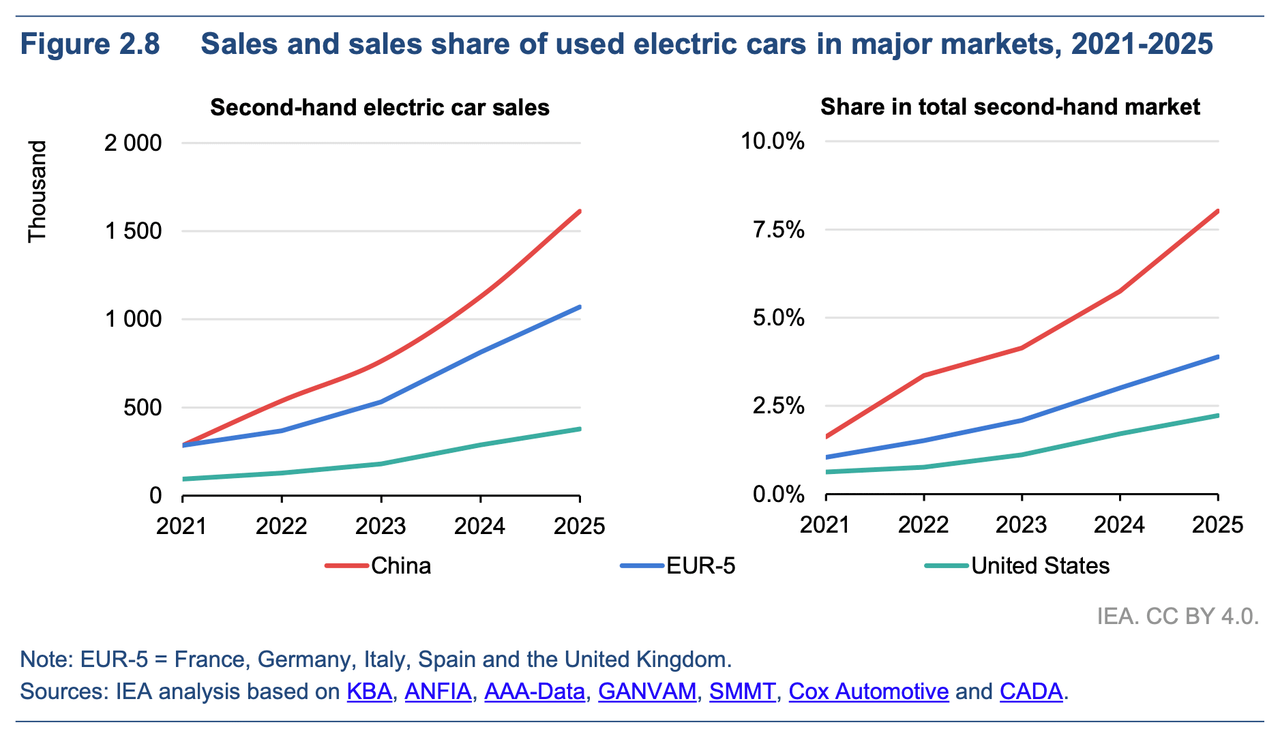
Over the past few years, the share of electric cars in the second-hand market has grown steadily across major regions. Across China, five key European markets (France, Germany, Italy, Spain and United Kingdom) and the United States, sales of used electric cars surpassed 3 million in 2025, an increase of around 35% compared with 2024.
Resale values in China are taking a hit from new, cheaper models
With around 13% of China’s car fleet now electric, the second-hand market is also becoming increasingly electrified. In 2025, sales of used electric cars exceeded 1.5 million, around 8% of all used car sales, reflecting strong new car uptake in recent years and large numbers of electric cars cycling out of initial ownership for the first time. Turnover was also supported by the scrappage and trade-in scheme (see Chapter 1), in which a subsidy of up to CNY 15 000 (Yuan renminbi) (USD 2 000) is provided if a new electric car is bought to replace an older car, CNY 2 000 (USD 275) more than the subsidy received when buying a new conventional car.
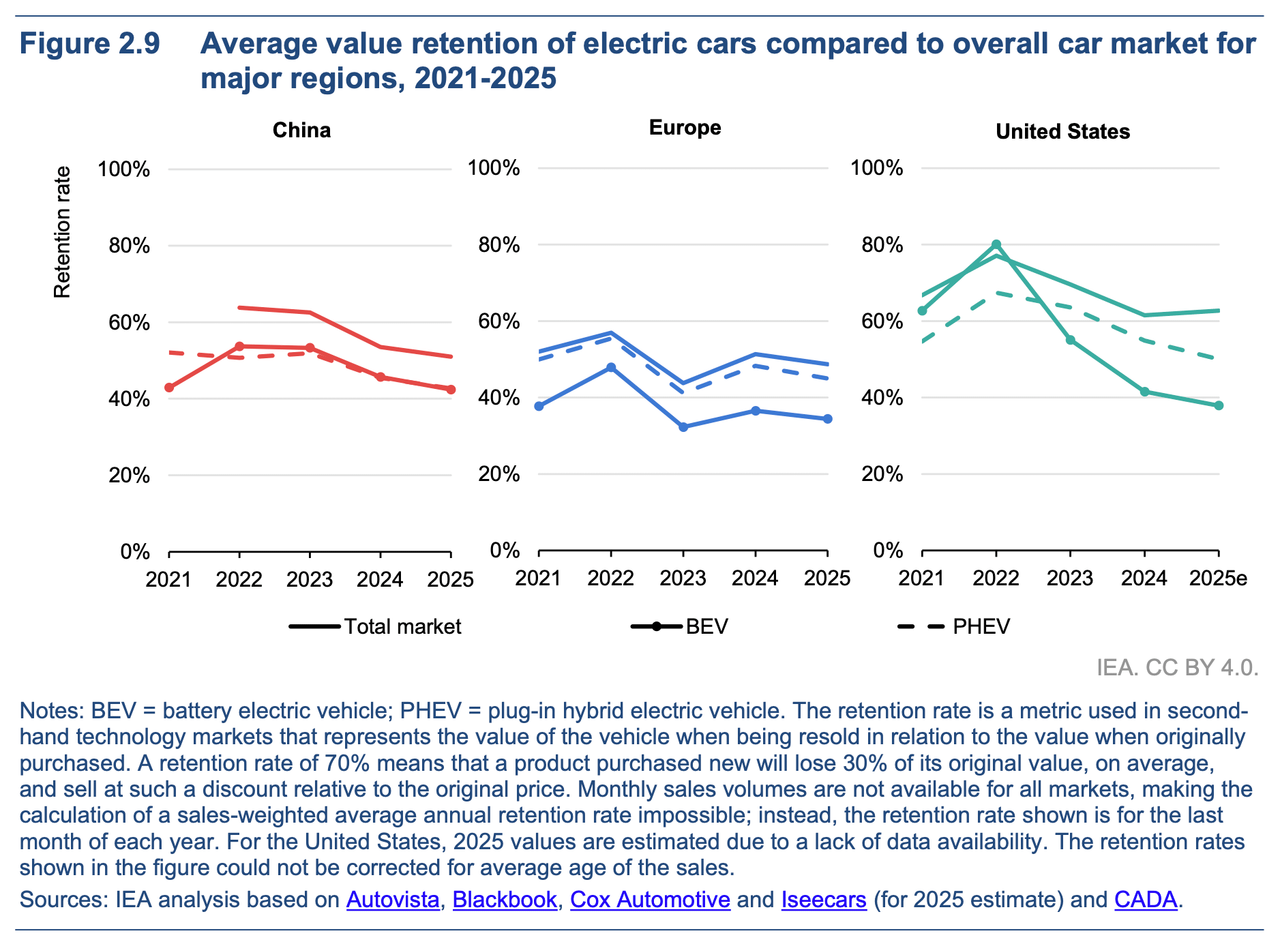
In 2024, the levels of electric car resale value retention were lower than the overall levels in China – about 46% for 3-year-old electric cars, compared to around 55% across the broader used car market. By late 2025, average BEV and PHEV resale values had fallen to 42%, a similar percentage point decrease as in the overall used car market, where levels declined to just above 50%. There are several reasons for the difference in depreciation rates between electric and ICE cars in China. Rapid advances in battery technology have quickly made newer electric models far more attractive, accelerating the depreciation of older electric cars. While electric cars generally require less routine maintenance than conventional cars, concerns about battery health and the potential cost of major repairs make the purchase of an older electric car less appealing. So much so that it is estimated that around 80% of used car dealers in China now refuse to accept BEVs that are more than 5 years old.
In Europe, resale values for battery electric cars have decreased since 2022 as supply and demand balanced out
In Europe, only around four in ten of all new car registrations are made by private buyers, while the majority are purchased by company fleets, dealerships or short-term rental firms. As the share of private buyers has steadily declined over the past decade, the choices made by corporate fleets have become increasingly influential, shaping the pace and direction of Europe’s fleet build-up. Across the five European markets analysed – France, Germany, Italy, Spain and the United Kingdom – electric cars represented roughly 4% of used car transactions in 2025, increasing from only 1% in 2021.
Market conditions differ across countries. The United Kingdom remains the largest overall second-hand market among the five, with sales of nearly 8 million used cars in 2025. Meanwhile, Germany recorded the highest sales of used electric cars by volume – around 400 000 – in 2025, corresponding to a little over 6% of the country’s used car market.
In 2022, tight supply of used cars lifted resale values across all powertrains in the five European countries analysed. As supply and demand have since rebalanced, overall value retention has declined. However, the value retention of BEVs has weakened more noticeably. Across the five markets, battery electric car retention rates fell from a peak of about 50% in 2022 to 35% in 2025, compared with the overall market’s drop from around 60% to 50%. PHEVs show a similar pattern: While PHEVs were broadly aligned with average resale values in 2022, their performance began to diverge from 2023 onwards. The steepest decline was observed in Germany, where PHEV retention rates matched that of the overall market in 2022 but fell to an average of 45% by the end of 2025, around four percentage points below the market average.
US second-hand electric car market remains volatile
The United States remains the smallest used electric car market among the regions analysed, with less than 400 000 electric car transactions in 2025, representing roughly 2.5% of all used car sales. Despite the market’s limited size, activity accelerated last year, as 2025 marked the final year of eligibility for federal tax rebates on second-hand EVs (see below), contributing to a 30% increase in used EV sales compared with 2024. Tesla continued to dominate the segment, securing three of the top five positions in the ranking of used EV models sold in the United States. About 40% of used EVs sold for under USD 25 000, significantly less than a new electric car in the United States (see above), with a used Nissan LEAF remaining one of the most accessible models, priced at about USD 12 000.
Resale values in the United States have been highly volatile compared with other major markets. In 2022, BEV resale values outperformed the overall used car market, reflecting the limited availability of electric models at the time. This trend reversed sharply in 2023 following Tesla’s price cuts for new cars, which rapidly eroded used EV pricing. By mid-2025, BEV resale values had fallen further amid a rush to capitalise on the expiring tax incentives for second-hand cars, which provided a tax rebate of USD 4 000 for used vehicles priced below USD 25 000. In contrast, overall used car prices increased, driven in part by tariff-related cost pressures. As a result, BEV resale values ended 2025 roughly 25 percentage points below the overall market.
…
The used car market could provide an important avenue for affordability
The most common way to buy a car is second-hand
Second-hand markets play a central role in enabling mass-market adoption of electric cars. Most people do not buy new cars; instead, they buy used cars because upfront costs are lower, making car ownership more affordable. For example, across Europe around eight in ten people purchase their car second-hand, and this share rises to roughly nine in ten among low- and middle-income households.
Besides increasing affordability for individual owners, the second-hand car market is important for fleet operators and leasing companies, which purchase large volumes of new cars and rely on stable residual values to manage costs and risks. In general, the price of a lease is designed to account for the depreciation of a vehicle over the typical 3-year lease period. Predictable resale values for electric cars, on par with those of conventional cars, help stimulate new electric car registrations, support fleet turnover, and increase the supply of affordable used vehicles entering the market following their first lease.
Over the past few years, the share of electric cars in the second-hand market has grown steadily across major regions. Across China, five key European markets (France, Germany, Italy, Spain and United Kingdom) and the United States, sales of used electric cars surpassed 3 million in 2025, an increase of around 35% compared with 2024.
Resale values in China are taking a hit from new, cheaper models
With around 13% of China’s car fleet now electric, the second-hand market is also becoming increasingly electrified. In 2025, sales of used electric cars exceeded 1.5 million, around 8% of all used car sales, reflecting strong new car uptake in recent years and large numbers of electric cars cycling out of initial ownership for the first time. Turnover was also supported by the scrappage and trade-in scheme (see Chapter 1), in which a subsidy of up to CNY 15 000 (Yuan renminbi) (USD 2 000) is provided if a new electric car is bought to replace an older car, CNY 2 000 (USD 275) more than the subsidy received when buying a new conventional car.
In 2024, the levels of electric car resale value retention were lower than the overall levels in China – about 46% for 3-year-old electric cars, compared to around 55% across the broader used car market. By late 2025, average BEV and PHEV resale values had fallen to 42%, a similar percentage point decrease as in the overall used car market, where levels declined to just above 50%. There are several reasons for the difference in depreciation rates between electric and ICE cars in China. Rapid advances in battery technology have quickly made newer electric models far more attractive, accelerating the depreciation of older electric cars. While electric cars generally require less routine maintenance than conventional cars, concerns about battery health and the potential cost of major repairs make the purchase of an older electric car less appealing. So much so that it is estimated that around 80% of used car dealers in China now refuse to accept BEVs that are more than 5 years old.
In Europe, resale values for battery electric cars have decreased since 2022 as supply and demand balanced out
In Europe, only around four in ten of all new car registrations are made by private buyers, while the majority are purchased by company fleets, dealerships or short-term rental firms. As the share of private buyers has steadily declined over the past decade, the choices made by corporate fleets have become increasingly influential, shaping the pace and direction of Europe’s fleet build-up. Across the five European markets analysed – France, Germany, Italy, Spain and the United Kingdom – electric cars represented roughly 4% of used car transactions in 2025, increasing from only 1% in 2021.
Market conditions differ across countries. The United Kingdom remains the largest overall second-hand market among the five, with sales of nearly 8 million used cars in 2025. Meanwhile, Germany recorded the highest sales of used electric cars by volume – around 400 000 – in 2025, corresponding to a little over 6% of the country’s used car market.
In 2022, tight supply of used cars lifted resale values across all powertrains in the five European countries analysed. As supply and demand have since rebalanced, overall value retention has declined. However, the value retention of BEVs has weakened more noticeably. Across the five markets, battery electric car retention rates fell from a peak of about 50% in 2022 to 35% in 2025, compared with the overall market’s drop from around 60% to 50%. PHEVs show a similar pattern: While PHEVs were broadly aligned with average resale values in 2022, their performance began to diverge from 2023 onwards. The steepest decline was observed in Germany, where PHEV retention rates matched that of the overall market in 2022 but fell to an average of 45% by the end of 2025, around four percentage points below the market average.
US second-hand electric car market remains volatile
The United States remains the smallest used electric car market among the regions analysed, with less than 400 000 electric car transactions in 2025, representing roughly 2.5% of all used car sales. Despite the market’s limited size, activity accelerated last year, as 2025 marked the final year of eligibility for federal tax rebates on second-hand EVs (see below), contributing to a 30% increase in used EV sales compared with 2024. Tesla continued to dominate the segment, securing three of the top five positions in the ranking of used EV models sold in the United States. About 40% of used EVs sold for under USD 25 000, significantly less than a new electric car in the United States (see above), with a used Nissan LEAF remaining one of the most accessible models, priced at about USD 12 000.
Resale values in the United States have been highly volatile compared with other major markets. In 2022, BEV resale values outperformed the overall used car market, reflecting the limited availability of electric models at the time. This trend reversed sharply in 2023 following Tesla’s price cuts for new cars, which rapidly eroded used EV pricing. By mid-2025, BEV resale values had fallen further amid a rush to capitalise on the expiring tax incentives for second-hand cars, which provided a tax rebate of USD 4 000 for used vehicles priced below USD 25 000. In contrast, overall used car prices increased, driven in part by tariff-related cost pressures. As a result, BEV resale values ended 2025 roughly 25 percentage points below the overall market.
…
Edit history
Please sign in to view edit histories.
8 replies
 = new reply since forum marked as read
Highlight:
NoneDon't highlight anything
5 newestHighlight 5 most recent replies
RecommendedHighlight replies with 5 or more recommendations
= new reply since forum marked as read
Highlight:
NoneDon't highlight anything
5 newestHighlight 5 most recent replies
RecommendedHighlight replies with 5 or more recommendations
= new reply since forum marked as read
Highlight:
NoneDon't highlight anything
5 newestHighlight 5 most recent replies
RecommendedHighlight replies with 5 or more recommendations
Close to 30% of cars sold this year are set to be electric as countries and consumers respond to energy crisis [View all]
OKIsItJustMe
Wednesday
OP
For a few decades now, I've said "So long as SUV's are the most popular vehicles in America, gas prices are too low."
OKIsItJustMe
Wednesday
#5
The irony is that trump and the degenerates worked so hard to destroy electric cars and
lostincalifornia
Wednesday
#6