James Hansen et al -- 2026 On Track for Warmest Year [View all]
http://www.columbia.edu/~jeh1/mailings/2026/2026GlobalTemperature.2026.04.30.pdf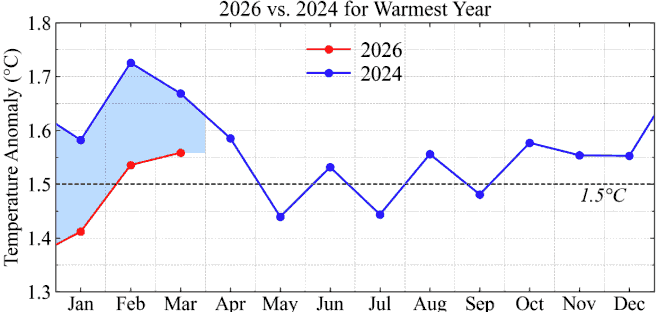
Fig. 1. Global surface temperature anomaly in GISS analysis ¹ relative to 1880-1920 mean.
2026 On Track for Warmest Year
30 April 2026
James Hansen, Pushker Kharecha, Dylan Morgan and Jasen Vest
Abstract. We infer that 2026 is likely to be the warmest year in the period of instrumental data, based on a physics-based approach with identifiable assumptions. This approach may help us learn something in 2026 about the mechanisms of climate change.
The figures in this post and our other current papers will be continually updated on our website, ² when they remain relevant. We are also now on Substack³ .
A Carbon Brief article last week (“
Strong El Nino Puts 2026 on Track for Second Warmest Year”) ⁴ makes us wonder about the basis for such expert projection. We are reminded of IPCC (Intergovernmental Panel on Climate Change) expert projections with unstated assumptions and whose physical basis is inscrutable to the public. Organized climate model runs for the Climate Model Intercomparison Project (CMIP) are valuable for climate analyses, but the fog of all model results should not be misinterpreted as a probability distribution for the real world.
As an alternative, let’s try a physics-based approach, with the hope to learn something from it by the end of the year. Specifically, let’s assume that the budding El Nino will have strength at least comparable to the 2023-24 El Nino. We assume that global temperature change is caused by climate forcings (imposed changes of the planet’s energy balance) and that “Nino” variability is the only substantial source of global “noise,” i.e., unforced global temperature change.
Why is this exercise of interest? Because, as we discussed in prior posts, the main issue is not El Nino, but the need to understand accelerated warming, unprecedented marine heat waves, and increasing climate extremes. The high rate of global warming acceleration was not anticipated by IPCC because their best estimate for climate sensitivity (3°C for 2×CO₂ ) was an underestimate. We have shown in four independent ways, with greater than 99% confidence, that climate sensitivity is substantially higher, 4-5°C for doubled CO₂ . ⁵ IPCC compensated for low climate sensitivity by failing to recognize that aerosol cooling increased during 1970-2005. Since then, especially since 2015, a reduction of aerosols and their cooling effect has caused the decadal growth rate of net climate forcing to be about double what it was in 1970-2005. ⁶ This increased net forcing combines with high climate sensitivity to cause recent global warming acceleration.
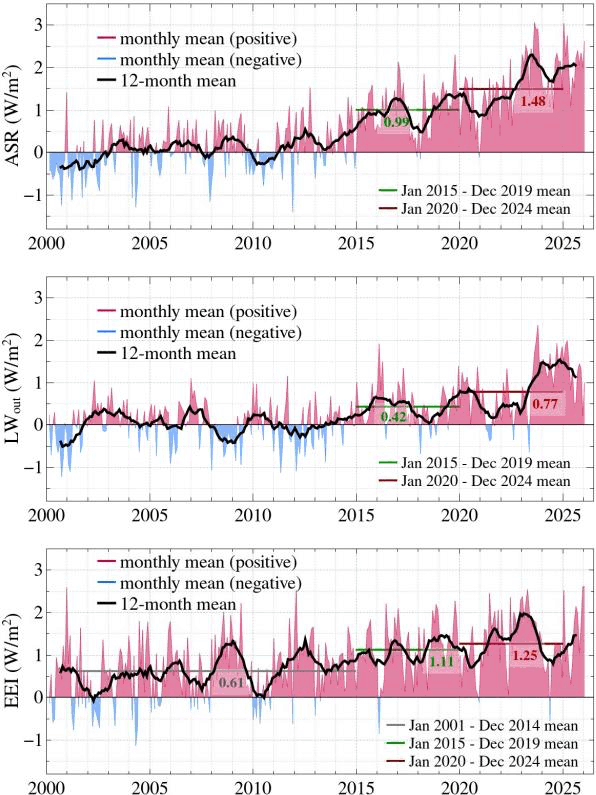
Fig. 2. Earth’s satellite-observed absorbed solar radiation (ASR) and longwave (thermal) emission to space (LW), ⁷ both relative to their 2000-2010 averages, and the absolute Earth energy imbalance (EEI) calibrated with aid of Argo-measured heat storage in the ocean.⁸
…
I strongly encourage you. to read
the entire PDF.

 = new reply since forum marked as read