The Event
An unusually early spring heatwave is developing across the southwestern United States (US), with temperatures that are more typical of summer than mid-March (
AccuWeather, 16 March 2026). Driven by a strong, slow-moving high pressure system, called a ‘heat dome’, the event is causing temperatures to rise 11-17℃ (
20-30℉) above average across parts of California, Nevada and Arizona (
BBC, 17 March 2026). In many areas, temperatures are expected to exceed 37.8℃ (
100℉). In Phoenix, temperature forecasts show multiple consecutive days of around 41.1℃ (
106℉), a huge increase over the previous all-time March record of 100℉.
The heatwave poses a significant public health threat, particularly given its timing early in the season. The persistent heat dome is creating stable atmospheric conditions, suppressing cloud formation and precipitation, while allowing temperatures to climb, thus expected to cause persistent heat. Extreme heat is the leading cause of weather-related fatalities in the US. Limited overnight cooling and the lack of air-conditioning is expected to add to the heat stress, particularly for vulnerable populations in these parts who are not acclimatised to the heat, including tourists from cooler countries (
CNN, 17 March 2026). This heat dome is breaking records for this time of the year, and is in some ways comparable to the persistent system that caused the 2021 Pacific Northwest (PNW) Heatwave. The PNW event occurred later in the year, in June, with temperatures of up to 48.9℃ (
120℉) causing hundreds of fatalities (
BBC, 17 March 2026).
The impacts of this early-season heatwave are likely to extend beyond health and have environmental implications. High temperatures are expected to accelerate snowmelt in these parts, including the mountains of Colorado where the snowpack levels are already lowest since 1981 due to the preceding warm winter, and the Sierra Nevada region in California, where although snowfall was average, the high heat is likely to drive rapid snowmelt. Early snowmelt in these parts can reduce water availability during the summer months, increasing the risk of water shortages, prolonging and intensifying dry seasons and increasing wildfire danger (
Gergel et al., 2017;
Uzun et al., 2021)
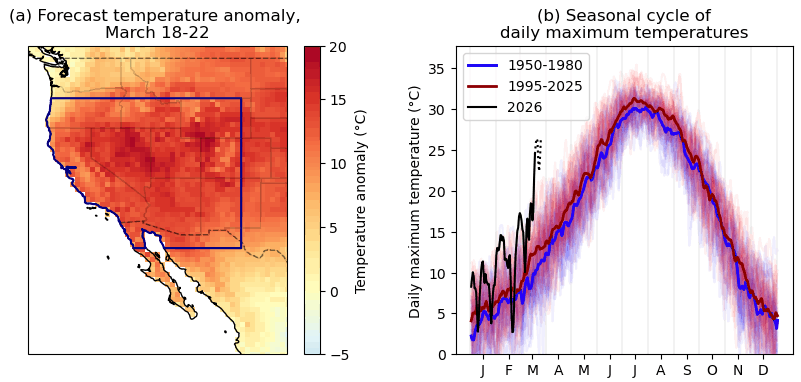 Figure 1: a) Forecasted temperature anomaly over western North America for the period 18th - 22nd March 2026. The study region is shown in dark blue. b) Seasonal cycles of daily maximum temperature within the study region shown in panel (a) for all years since 1950 (shown as thinner lines, coloured blue-red depending on proximity to present day), with 2026 shown in black. The bold red and blue lines show the present (1995-2025) and past (1950-1980) climatology. Data: ERA5.
…

 = new reply since forum marked as read