Why a Small Election in England Will Have Giant Consequences [View all]
Here is what to know about the by-election on Thursday in Makerfield, the outcome of which could lead to Prime Minister Keir Starmer’s ouster.
https://www.nytimes.com/2026/06/18/world/europe/uk-makerfield-by-election-burnham-starmer.html
https://archive.ph/6Vqpb
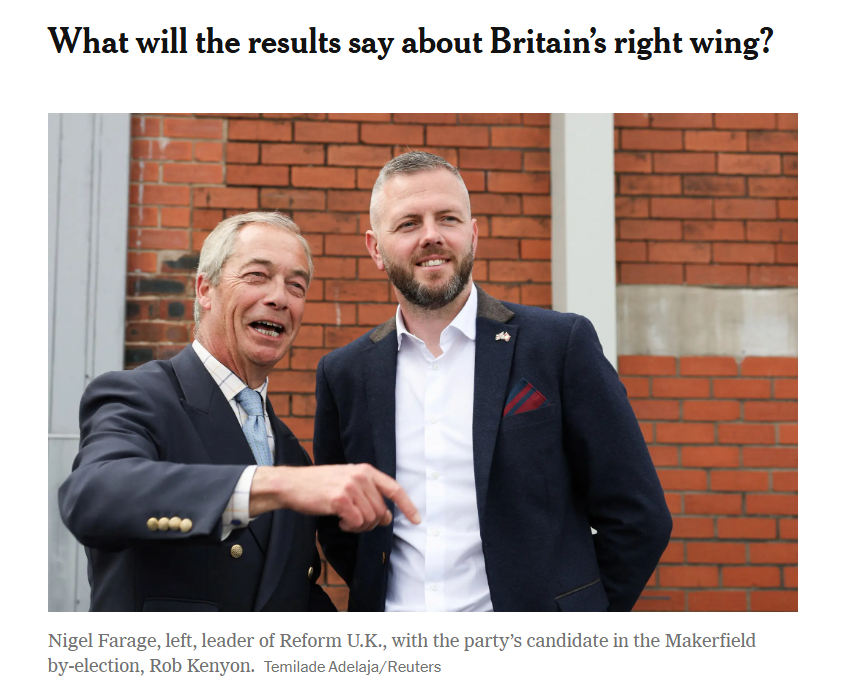
 Voters in the northern English district of Makerfield cast ballots on Thursday to choose their representative in Parliament, the outcome of which could lead to Prime Minister Keir Starmer’s ouster.CreditCredit...Temilade Adelaja/Reuters
Voters in Makerfield, an electoral district in northern England, are going to the polls on Thursday for a special election. The outcome of the race has the potential to reshape Britain. At one level, the contest is typical, with many candidates focused on hyperlocal issues including garbage collection, potholes and money for schools. But in other ways, it is unique. Andy Burnham, the Labour Party candidate, is running to become a lawmaker so that he can challenge Prime Minister Keir Starmer for leadership of the party. If that happens, Mr. Burnham could become Britain’s next prime minister. Here is what to know.
Why is Britain holding this election in the first place?
The special election, known as a by-election in Britain, was
triggered after a Labour lawmaker, Josh Simons, resigned to make way for Mr. Burnham, the mayor of Greater Manchester. If Mr. Burnham wins, he will be eligible to challenge Mr. Starmer, whose popularity has plunged to some of the lowest levels of any prime minister in modern British history. In surveys, people say they are angry about the economy, public services, taxes and immigration — but also express visceral dislike of the prime minister himself. Mr. Starmer has made progress on tackling some issues but not enough to turn round public opinion. Mr. Burnham, a more charismatic communicator and Labour’s most popular politician, is viewed within the party as its best hope of winning back voters. In Makerfield, Labour faces particular competition from Reform U.K., the populist, right-wing party. Reliable polling is scarce, but insiders believe the outcome could be close.
Who is Andy Burnham, and what does he stand for?
Mr. Burnham, 56, was born on the outskirts of Liverpool and grew up in
Culcheth, not far from Makerfield. His northern roots have shaped his politics, and he has long complained about Westminster and the news media being too
London-centric. The longest stretch in his career was as the member of Parliament for Leigh, in Greater Manchester, from 2001 until 2017. As a lawmaker, Mr. Burnham rose rapidly, becoming the culture secretary and later health secretary under Prime Minister Gordon Brown. He tried twice to become Labour’s leader, in 2010 and in 2015, when he was the early
front-runner, but lost to the hard-left
Jeremy Corbyn. Disenchanted with Westminster, Mr. Burnham left Parliament and won the mayoral election in Greater Manchester. In 2021, he won again with an even larger vote share.
Mr. Burnham’s almost 10 years as mayor coincided with a period of
economic growth in Manchester. He won praise from locals during the Covid-19 pandemic, when
he made a speech angrily criticizing the Conservative government over the effects of its lockdowns on his region. He took the city’s buses back into public ownership,
making some rides free. Along the way, he transformed his political identity into that of an outsider to the government in London. And he gained a reputation as a plain talker who understands the needs of working people. Critics have pointed to his limited foreign policy experience, which they say could be a weakness for a future prime minister in a world facing protracted wars and geopolitical tension.
snip

 = new reply since forum marked as read