Welcome to DU!
The truly grassroots left-of-center political community where regular people, not algorithms, drive the discussions and set the standards.
Join the community:
Create a free account
Support DU (and get rid of ads!):
Become a Star Member
Latest Breaking News
Editorials & Other Articles
General Discussion
The DU Lounge
All Forums
Issue Forums
Culture Forums
Alliance Forums
Region Forums
Support Forums
Help & Search
American History
Related: About this forumOn May 17, 1954, the U.S. Supreme Court unanimously ruled that segregation in public education was unconstitutional.
On this day May 17, 1954
Supreme Court Decision Sparks Massive White Resistance to School Integration
Voices of the Civil Rights Movement
On May 17, 1954, the U.S. Supreme Court unanimously ruled that segregation in public education was unconstitutional, overturning the "separate but equal" doctrine in place since 1896 and sparking massive resistance among white Americans committed to racial inequality.
The Supreme Court's landmark decision in Brown v. Board of Education grew out of several cases challenging racial segregation in school districts across America, filed as part of the NAACP Legal Defense Fund's strategy to bar the practice nationwide. In the named case, a Black man named Oliver Brown sued the Board of Education in Topeka, Kansas, for refusing to allow his daughter Linda to attend the elementary school nearest her house solely due to her race.
{snip}
Supreme Court Decision Sparks Massive White Resistance to School Integration
Voices of the Civil Rights Movement
On May 17, 1954, the U.S. Supreme Court unanimously ruled that segregation in public education was unconstitutional, overturning the "separate but equal" doctrine in place since 1896 and sparking massive resistance among white Americans committed to racial inequality.
The Supreme Court's landmark decision in Brown v. Board of Education grew out of several cases challenging racial segregation in school districts across America, filed as part of the NAACP Legal Defense Fund's strategy to bar the practice nationwide. In the named case, a Black man named Oliver Brown sued the Board of Education in Topeka, Kansas, for refusing to allow his daughter Linda to attend the elementary school nearest her house solely due to her race.
{snip}
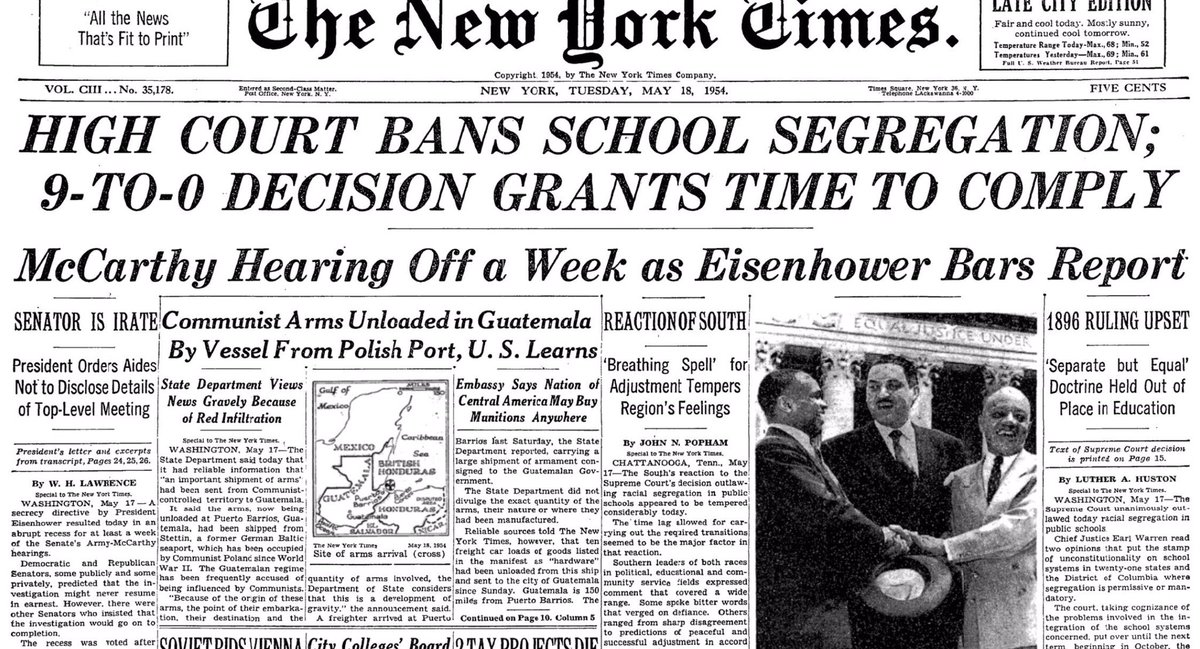
Unanimous Supreme Court decided Brown v. Board of Education tomorrow 1954:
Link to tweet
Brown v. Board of Education
Argued December 9, 1952
Reargued December 8, 1953
Decided May 17, 1954
Full case name: Oliver Brown, et al. v. Board of Education of Topeka, et al.
Brown v. Board of Education of Topeka, 347 U.S. 483 (1954), was a landmark decision by the U.S. Supreme Court, which ruled that U.S. state laws establishing racial segregation in public schools are unconstitutional, even if the segregated schools are otherwise equal in quality. The decision partially overruled the Court's 1896 decision Plessy v. Ferguson, which had held that racial segregation laws did not violate the U.S. Constitution as long as the facilities for each race were equal in quality, a doctrine that had come to be known as "separate but equal". The Court's decision in Brown paved the way for integration and was a major victory of the civil rights movement, and a model for many future impact litigation cases.
The underlying case began in 1951 when the public school system in Topeka, Kansas, refused to enroll local black resident Oliver Brown's daughter at the elementary school closest to their home, instead requiring her to ride a bus to a segregated black school farther away. The Browns and twelve other local black families in similar situations filed a class-action lawsuit in U.S. federal court against the Topeka Board of Education, alleging that its segregation policy was unconstitutional. A special three-judge court of the U.S. District Court for the District of Kansas rendered a verdict against the Browns, relying on the precedent of Plessy and its "separate but equal" doctrine. The Browns, represented by NAACP chief counsel Thurgood Marshall, then appealed the ruling directly to the Supreme Court.
In May 1954, the Supreme Court issued a unanimous 9–0 decision in favor of the Browns. The Court ruled that "separate educational facilities are inherently unequal", and therefore laws that impose them violate the Equal Protection Clause of the Fourteenth Amendment of the U.S. Constitution. However, the decision's 14 pages did not spell out any sort of method for ending racial segregation in schools, and the Court's second decision in Brown II (349 U.S. 294 (1955)) only ordered states to desegregate "with all deliberate speed".
In the Southern United States, especially the "Deep South", where racial segregation was deeply entrenched, the reaction to Brown among most white people was "noisy and stubborn". Many Southern governmental and political leaders embraced a plan known as "Massive Resistance", created by Virginia Senator Harry F. Byrd, in order to frustrate attempts to force them to de-segregate their school systems. Four years later, in the case of Cooper v. Aaron, the Court reaffirmed its ruling in Brown, and explicitly stated that state officials and legislators had no power to nullify its ruling.
{snip}
Argued December 9, 1952
Reargued December 8, 1953
Decided May 17, 1954
Full case name: Oliver Brown, et al. v. Board of Education of Topeka, et al.
Brown v. Board of Education of Topeka, 347 U.S. 483 (1954), was a landmark decision by the U.S. Supreme Court, which ruled that U.S. state laws establishing racial segregation in public schools are unconstitutional, even if the segregated schools are otherwise equal in quality. The decision partially overruled the Court's 1896 decision Plessy v. Ferguson, which had held that racial segregation laws did not violate the U.S. Constitution as long as the facilities for each race were equal in quality, a doctrine that had come to be known as "separate but equal". The Court's decision in Brown paved the way for integration and was a major victory of the civil rights movement, and a model for many future impact litigation cases.
The underlying case began in 1951 when the public school system in Topeka, Kansas, refused to enroll local black resident Oliver Brown's daughter at the elementary school closest to their home, instead requiring her to ride a bus to a segregated black school farther away. The Browns and twelve other local black families in similar situations filed a class-action lawsuit in U.S. federal court against the Topeka Board of Education, alleging that its segregation policy was unconstitutional. A special three-judge court of the U.S. District Court for the District of Kansas rendered a verdict against the Browns, relying on the precedent of Plessy and its "separate but equal" doctrine. The Browns, represented by NAACP chief counsel Thurgood Marshall, then appealed the ruling directly to the Supreme Court.
In May 1954, the Supreme Court issued a unanimous 9–0 decision in favor of the Browns. The Court ruled that "separate educational facilities are inherently unequal", and therefore laws that impose them violate the Equal Protection Clause of the Fourteenth Amendment of the U.S. Constitution. However, the decision's 14 pages did not spell out any sort of method for ending racial segregation in schools, and the Court's second decision in Brown II (349 U.S. 294 (1955)) only ordered states to desegregate "with all deliberate speed".
In the Southern United States, especially the "Deep South", where racial segregation was deeply entrenched, the reaction to Brown among most white people was "noisy and stubborn". Many Southern governmental and political leaders embraced a plan known as "Massive Resistance", created by Virginia Senator Harry F. Byrd, in order to frustrate attempts to force them to de-segregate their school systems. Four years later, in the case of Cooper v. Aaron, the Court reaffirmed its ruling in Brown, and explicitly stated that state officials and legislators had no power to nullify its ruling.
{snip}
Fri May 17, 2024: On this day, May 17, 1954, Brown v. Board of Education was decided.
Wed May 17, 2023: On this day, May 17, 1954, Brown v. Board of Education was decided.
2 replies
 = new reply since forum marked as read
Highlight:
NoneDon't highlight anything
5 newestHighlight 5 most recent replies
= new reply since forum marked as read
Highlight:
NoneDon't highlight anything
5 newestHighlight 5 most recent replies
= new reply since forum marked as read
Highlight:
NoneDon't highlight anything
5 newestHighlight 5 most recent replies
On May 17, 1954, the U.S. Supreme Court unanimously ruled that segregation in public education was unconstitutional. (Original Post)
mahatmakanejeeves
9 hrs ago
OP

GiqueCee
(4,726 posts)1. The facial expressions of hatred and malice...
... on Southerners protesting that decision were sickening to behold. And not much has changed in 72 years; they're just a little bit better at hiding it.

70sEraVet
(5,614 posts)2. An unfortunate result, was that churches became a tool of segregationists
Private religious schools popped up all over the South, as a way for whites to avoid the 'horrors' of integration.
One wonders how many of today's most rabid racists were 'educated' at these facilities? And, how many churches evolved to become, not just a tool of segregationists, but ENGINES of racial hatred?
If only today's six Supreme Court Justices could be replaced with six Thurgood Marshalls!!