Welcome to DU!
The truly grassroots left-of-center political community where regular people, not algorithms, drive the discussions and set the standards.
Join the community:
Create a free account
Support DU (and get rid of ads!):
Become a Star Member
Latest Breaking News
Editorials & Other Articles
General Discussion
The DU Lounge
All Forums
Issue Forums
Culture Forums
Alliance Forums
Region Forums
Support Forums
Help & Search
Cooking & Baking
Related: About this forum
A Traditional Entree & Sides: From "German Meals at Omas" 🌞
Last edited Tue Dec 16, 2025, 07:10 PM - Edit history (1)
After all, you need to know what to fix with that scrumptious main course!
SAUERBRATEN
(Marinated Braised Beef)
This recipe is a wonderful example from my mutti‘s
handwritten cookbook. Served with potato dumplings and
red cabbage, it was a meal reserved for special occasions.
The meat was always so tender and the gravy was a perfect
counterpoint to the red cabbage. What’s really awesome is
that this is actually quite easy to make. Much of the
preparation happens days before you actually cook the
meat, making this a great dish for a busy holiday feast.
Serves 4
MARINADE
¾ cup (180 ml) dry red wine
½ cup (125 ml) red wine vinegar
1 cup (250 ml) water
1 medium onion, quartered
2 cloves
6 black peppercorns
2 dried bay leaves
1 tsp salt
ROAST
2 lb (908 g) beef rump, chuck or bottom round roast
Salt and freshly ground black pepper, as needed
3 tbsp (45 g) butter, divided 1 large carrot, thickly sliced
1 medium onion, thickly sliced
1 cup (227 g) cubed celeriac or 1 cup (100 g) coarsely chopped
celery
2 cups (500 ml) beef broth or 1 cup (250 ml) beef broth and 1
cup (250 ml) reserved marinade
2 tbsp (19 g) cornstarch mixed with 2 tbsp (30 ml) cold water
½ cup (115 g) sour cream
To make the marinade, pour the wine, vinegar, water, onion, cloves,
peppercorns, bay leaves and salt in a medium saucepan. Bring to a
boil over high heat. Remove the saucepan from the heat and let the
marinade cool.
To make the roast, put the beef in a resealable freezer bag. Pour the
cooled marinade over the beef. Seal the bag. Refrigerate the beef for
3 to 5 days, turning it over twice a day.
Remove the beef and strain the marinade into a bowl, reserving it if
you will be adding it to the gravy. Dry the beef completely with
paper towels and sprinkle it with salt and pepper.
Melt 2 tablespoons (30 g) of the butter in a large saucepan over
medium-high heat. Add the beef and brown it well on all sides,
about 2 minutes on each side. Transfer the beef to a plate. Add the
remaining 1 tablespoon (15 g) of the butter, the carrot, onion and
celeriac to the saucepan. Sauté for about 5 minutes, or until the
vegetables are slightly softened. Add the broth and the reserved
marinade (if using), stirring up the browned bits on the bottom of
the saucepan. Transfer the beef back to the saucepan, reduce the
heat to low and bring the liquid to a simmer. Cover the saucepan
and cook for 2 to 2½ hours, or until the meat is tender.
Transfer the roast to a serving platter and tent it with foil to keep it
warm. Either strain the gravy through a sieve and return it to the
saucepan or use an immersion blender to create a smooth
consistency. Bring the gravy to a boil over medium heat, stirring in
just enough cornstarch slurry to thicken it. Simmer for 1 minute and
remove from the heat.
In a small bowl, temper the sour cream by stirring several spoonfuls
of hot gravy into the sour cream. Stir the sour cream mixture into
the gravy. Season the gravy with salt and pepper. Slice the
sauerbraten and serve with the gravy on the side.
Oma’s Ecke
Traditional sides for this dish are **Apfel-Rotkohl (Red
Cabbage with Apples) and Schneebällchen (Potato
Dumplings from Cooked Potatoes). Alternatively,
Kartoʃelpuʃer (Potato Pancakes) and applesauce taste
wunderbar with sauerbraten.
****
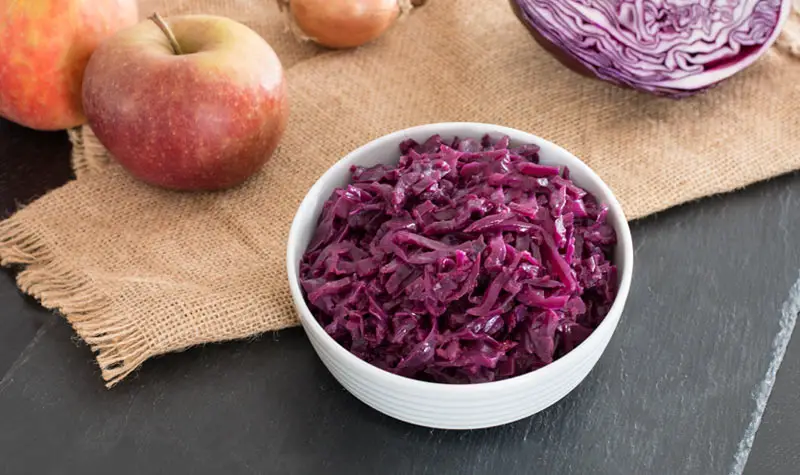
*** Apfel-Rotkohl
(Red Cabbage with Apples)
One of the most traditional of all vegetable dishes
throughout Germany is this sweet and sour red cabbage.
Perfectly at home beside Rouladen (Beef Rolls), Sauerbraten
(Marinated Braised Beef), roasts, poultry and game, it’s as
common at a fancy restaurant as it is in oma’s kitchen.
Since red cabbage can be used to dye yarn and Easter eggs,
you’ll need to protect your fingers and the cutting surface
from the red juices. Using disposable gloves and an
inexpensive plastic cutting board is the easiest way to do
this.
Serves 6 to 8
3 tbsp (45 g) butter or 3 tbsp (45 ml) bacon fat
2 cups (300 g) ɹnely diced onions
2 large Cortland or Granny Smith apples, peeled and diced
1¾ to 2 lb (800 to 908 g) red cabbage, shredded
1 tbsp (12 g) sugar
1 tsp salt, plus more as needed
¼ tsp freshly ground black pepper, plus more as needed
¼ tsp ground cloves (see Oma’s Ecke)
3 juniper berries, optional
1 dried bay leaf
2 tbsp (30 ml) red wine vinegar
½ cup (125 ml) fresh orange juice, optional
1 cup (250 ml) water
2 tbsp (19 g) cornstarch mixed with 2 tbsp (30 ml) cold water
2 tbsp (30 ml) red currant jelly, optional
Melt the butter in a large saucepan over medium heat. Add the
onions and sauté for 5 to 7 minutes, stirring occasionally, until they
are lightly caramelized. Add the apples and sauté for 2 minutes.
Add the cabbage, sugar, salt, pepper, cloves, juniper berries (if
using), bay leaf and vinegar. Add the orange juice (if using) and
water. Stir the mixture and bring it to a simmer. Cover the
saucepan, reduce the heat to low and simmer for 1 hour, stirring
occasionally and adding a bit more water, if necessary.
Stir the cornstarch slurry into the cabbage a little bit at a time, until
the cooking juices have thickened. Add the jelly (if using) and
season with additional salt and pepper. Add extra vinegar and
ground cloves if you prefer a spicier taste. Remove the bay leaf and
serve.
Oma’s Ecke
My mutti had a little trick up her sleeve. Since she only had
whole cloves and no way to grind them, she’d take an onion
and cut it in half through the middle. She’d poke the stems
of the whole cloves into the cut part of the onion. The clove
studded onion halves would go into the red cabbage for the
entire cooking time. At the end, the onions with the cloves
would be removed.
As a young wife, I forgot to do this and added the whole
cloves to the red cabbage. The taste was wonderful.
However, biting into a cooked clove was not much fun.
Since then, I’ve used ground cloves and sautéed the diced
onion instead so that it remains in the cabbage. If you do
plan on doing the clove-studded-onion trick, you will need
to use 4 to 6 cloves to get the same flavor.
****

*** Schneeballchen
Potato Dumplings from Cooked Potatoes
Snowballs, as they are known in the Palatinate region, or
kartoʃelknödel or kartoʃelklösse in most other regions, are
dumplings made from cooked potatoes. Ideally, the potatoes
should be cooked and riced the day before you make this
dish in order to get a purer dumpling. If you really want
them today, just cool the riced potatoes in the fridge as long
as you can before you start making the dumplings.
These dumplings are wonderful served with beef, pork or
turkey, especially when there’s a lot of gravy. Leftovers can
be sliced and fried in butter for a delicious and easy lunch
the next day.
Serves 4
2¼ lbs (1 kg) russet potatoes, washed and unpeeled
1½ tsp (8 g) salt, divided
1⅓ cups (213 g) potato flour or cornstarch, divided
2 large eggs
Pinch of freshly grated nutmeg
Prepare the potatoes by putting them in a large pot, covering them
with cold water and bringing them to a boil over high heat. Reduce
the heat to medium-low to bring the water to a gentle boil, cover
the pot and cook until the potatoes are tender, 20 to 40 minutes,
depending on their size. Check that the potatoes can be easily
pierced with a knife. Drain the potatoes, rinse them brieɻy under
cold water and let them cool slightly. Peel them and press the warm
potatoes through a potato ricer into a large bowl. Let the riced
potatoes cool completely, cover the bowl and refrigerate the
potatoes overnight.
When you are ready to make the dumplings, ɹll a large pot with
water and add 1 teaspoon of the salt. Bring the water to a boil over
high heat. Cover the pot, reduce the heat to medium-low and bring
the water to a simmer.
Add 1 cup (160 g) of the ɻour, the eggs, the remaining ½ teaspoon
of salt and the nutmeg to the riced potatoes. Mix well using your
hands. Add the remaining ⅓ cup (53 g) of ɻour, as needed, in order
to get a smooth dough. Lightly ɻour a work surface and transfer the
dough to the work surface. Dip your hands into a bit of ɻour and
then knead the dough very gently until it holds together.
It is a good practice to always make a test dumpling. Take ¼ cup
(60 g) of the dough and form it into a ball with your ɻoured hands.
Drop it gently into the simmering water. Cook 10 to 15 minutes,
uncovered, until the test dumpling ɻoats to the surface. If it falls
apart as it is cooking, add a bit more ɻour to the dough. Remove the
test dumpling with a slotted spoon and see if it is cooked through.
Form the rest of the dough into a thick log. Cut it into 12 to 14
equal pieces. Form each piece into a ball and cook, uncovered, for
10 to 15 minutes in the simmering water. Remove the dumplings
with a slotted spoon and place them on a serving plate. Serve
immediately.
Oma’s Ecke
Ideally, a potato ricer is the best tool to use here. It makes a
purer “mashed” potato and is actually the preferred way to
make mashed potatoes. If you don’t have a ricer, you can
use a potato masher, but try to be gentle and create a ɻuʃy
mash. Don’t use a mixer. It’ll create a gummy mash that will
produce gummy dumplings.
If you have croutons, tuck one or two into the middle of
each dumpling as you’re forming them. They add a lovely
ɻavor and texture and assure that there’s no uncooked
center in the dumpling. Use store-bought salad croutons or
fry cubes of bread in butter until they are toasty brown.

**** Kartoffelpuffer
(Potato Pancakes)
Called grumbeerpannekuche in Rhineland-Palatinate and
reibekuchen or kartoffelpfannkuchen in other regions, potato
pancakes are frequently enjoyed at street stalls, Christmas
markets and especially during karneval. One reason for this
is that many Germans don’t like to make these delicious
treats themselves at home—the frying smell seems to linger
in the house. However, I ɹnd that when using clarifed
butter, it smells delicious. There is nothing quite like
enjoying these potato pancakes right out of the pan and
making them just like Oma.
Serves 4
2½ lbs (1.1 kg) peeled starchy potatoes (such as russets), ɹnely
grated
1 medium onion, finely grated
3 large eggs
1 tsp salt
⅓ cup (50 g) all-purpose flour
½ cup (120 g) clariɹed butter or ½ cup (125 ml) neutral oil,
divided
Ensure that the grated potatoes are quite dry. You can put them in a
sieve over a bowl to drain for at least 1 hour, pressing on them with
a wooden spoon from time to time; or you can put them in a clean
dish towel, bring the corners together and twist to squeeze as much
liquid out of the potatoes as possible.
Preheat the oven to 250°F (121°C). Put a large baking sheet in the
oven. Put a paper towel on a plate near the stove.
In a large bowl, mix together the potatoes, onion, eggs, salt and
flour. Melt ¼ cup (60 g) of the butter in a large skillet over medium-high
heat. Using a large spoon or ladle (depending on the size of the
pancakes you want), scoop the potato mixture into the skillet,
pressing down to flatten the pancakes. Make sure that the pancakes
do not touch one another. Cook for 2 to 5 minutes, then carefully
flip the pancakes over when the edges have become browned. Cook
for 2 to 5 minutes, and once the other side has browned, transfer
the pancakes to the paper towel to drain. After they have drained,
put them on the baking sheet in the oven to keep them warm.
Repeat this process until all the potato mixture is used, adding the
remaining ¼ cup (60 g) of the butter as needed.
Serve the Kartoffelpuffer with applesauce, sour cream or sprinkle
them with sugar.
Oma’s Ecke
Blender Potato Pancakes: When our children were little, I
had a quick way to make these. I’d put 4 or 5 unpeeled new
potatoes, 1 large egg, about ¼ cup (38 g) of chopped onions,
½ teaspoon of salt and 2 tablespoons (15 g) of flour in my
blender. I’d pulse-blend the ingredients, scraping down the
sides of the blender occasionally, until all the ingredients
were mixed and little pieces of potatoes were left. (Going to
the smoothie stage was a no-no, since I was trying to imitate
the grated potato mixture.) Fried and served with sugar and
applesauce, these were always a hit. Were they identical to
the grated ones? No. But, that didn’t matter. They were
delicious and our family was fed and happy
All the above from From "German Meals at Omas"
https://www.goodreads.com/book/show/41487174-german-meals-at-oma-s
Thanks Granny! Deeelicious!!


