Welcome to DU!
The truly grassroots left-of-center political community where regular people, not algorithms, drive the discussions and set the standards.
Join the community:
Create a free account
Support DU (and get rid of ads!):
Become a Star Member
Latest Breaking News
Editorials & Other Articles
General Discussion
The DU Lounge
All Forums
Issue Forums
Culture Forums
Alliance Forums
Region Forums
Support Forums
Help & Search
Environment & Energy
Related: About this forum
Researchers demonstrate hydrogen as a viable aviation fuel
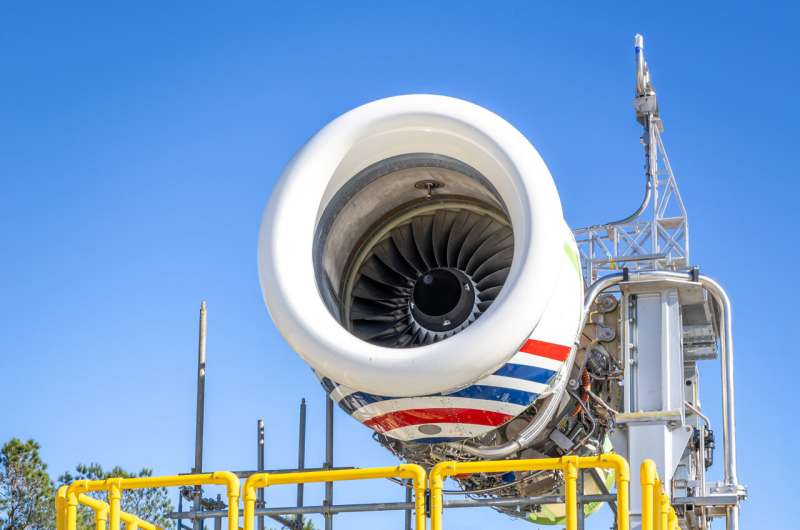
A modified Pearl 15 engine. Credit: Rolls-Royce plc 2026
Researchers demonstrate hydrogen as a viable aviation fuel
by Swansea University | June 8, 2026
Researchers from Swansea University are celebrating their role in a major aviation milestone following the successful completion of a four-year international program led by Rolls-Royce and easyJet to demonstrate hydrogen as a viable aviation fuel. The program has culminated in a world-first achievement: a modern aero engine running on 100% hydrogen at full takeoff power, proving the potential of hydrogen to play a transformative role in future zero-carbon aviation.
Swansea University provided critical materials data to support the development of hydrogen-fueled gas turbines as a core partner in the HYEST (Hydrogen Engine System Technologies) initiative.
As part of the project, Swansea's Institute of Structural Materials (ISM) established new world-class mechanical testing capabilities in two areas previously unexplored by the research group:
cryogenic temperatures
high-pressure hydrogen environments... more
https://techxplore.com/news/2026-06-hydrogen-viable-aviation-fuel.html
Hydrogen-Powered Flight Is Here: The Zero-Emission Planes Taking Off in 2026 | Mach Horizon
Bertrand Piccard on Hydrogen Aviation, Solar Impulse & the Future of Flight
1 replies
 = new reply since forum marked as read
Highlight:
NoneDon't highlight anything
5 newestHighlight 5 most recent replies
= new reply since forum marked as read
Highlight:
NoneDon't highlight anything
5 newestHighlight 5 most recent replies
= new reply since forum marked as read
Highlight:
NoneDon't highlight anything
5 newestHighlight 5 most recent replies
Researchers demonstrate hydrogen as a viable aviation fuel (Original Post)
Caribbeans
8 hrs ago
OP
Aviation contributes 3.5% to the drivers of climate change that stem from humans
OKIsItJustMe
6 hrs ago
#1

OKIsItJustMe
(22,291 posts)1. Aviation contributes 3.5% to the drivers of climate change that stem from humans
https://www.mmu.ac.uk/news-and-events/news/story/aviation-contributes-35-drivers-climate-change-stem-humans
Hydrogen-powered flight will still generate water vapor, and leave “contrails” - “condensation trails.”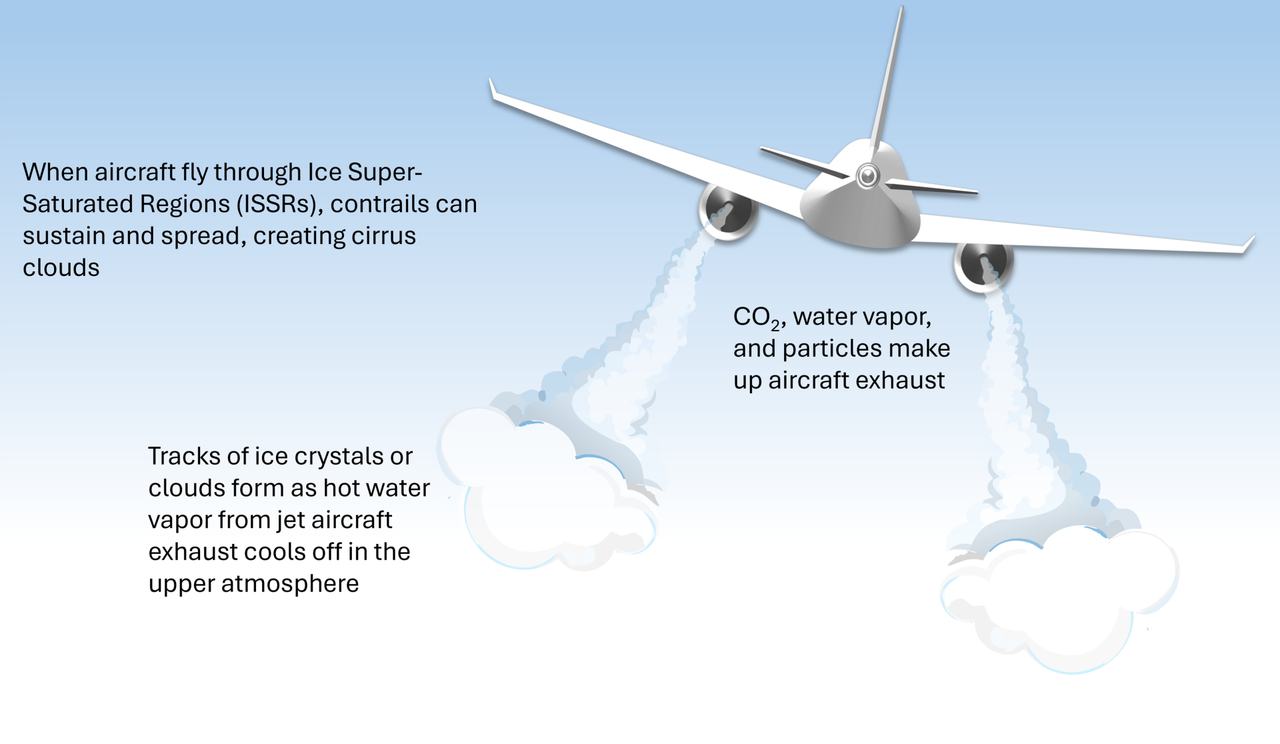
3 Sep 2020
…
Lead author David Lee, Professor of Atmospheric Science at Manchester Metropolitan University and Director of its Centre for Aviation, Transport, and the Environment research group, said the findings show that two-thirds of the impact from aviation is attributed to non-carbon dioxide emissions and the rest from CO2.
…
Using the new ERF metric, the team found that while contrail cirrus has the largest climate warming impact, it is less than half that previously estimated. The effects of CO2 emissions generated by aviation last for many centuries, and represent the second largest contribution. Approximately half the total cumulative emissions of CO2 were generated in the past 20 years.
“Given the dependence of aviation on burning fossil fuel, its significant CO2 and non-CO2 effects, and the projected fleet growth, it is vital to understand the scale of aviation’s impact on present-day climate change,” said lead author David Lee, professor of Atmospheric Science at Manchester Metropolitan University and Director of its Centre for Aviation, Transport, and the Environment research group.
Lee said that estimating aviation’s non-CO2 effects on atmospheric chemistry and clouds was a complex challenge. “We had to account for contributions caused by a range of atmospheric physical processes, including how air moves, chemical transformations, microphysics, radiation, and transport.”
…
1. Lee, D. S. et al. The contribution of global aviation to anthropogenic climate forcing for 2000 to 2018. Atmospheric Environment 244, 117834 (2021). https://doi.org/10.1016/j.atmosenv.2020.117834
…
Lead author David Lee, Professor of Atmospheric Science at Manchester Metropolitan University and Director of its Centre for Aviation, Transport, and the Environment research group, said the findings show that two-thirds of the impact from aviation is attributed to non-carbon dioxide emissions and the rest from CO2.
…
Using the new ERF metric, the team found that while contrail cirrus has the largest climate warming impact, it is less than half that previously estimated. The effects of CO2 emissions generated by aviation last for many centuries, and represent the second largest contribution. Approximately half the total cumulative emissions of CO2 were generated in the past 20 years.
“Given the dependence of aviation on burning fossil fuel, its significant CO2 and non-CO2 effects, and the projected fleet growth, it is vital to understand the scale of aviation’s impact on present-day climate change,” said lead author David Lee, professor of Atmospheric Science at Manchester Metropolitan University and Director of its Centre for Aviation, Transport, and the Environment research group.
Lee said that estimating aviation’s non-CO2 effects on atmospheric chemistry and clouds was a complex challenge. “We had to account for contributions caused by a range of atmospheric physical processes, including how air moves, chemical transformations, microphysics, radiation, and transport.”
…
Hydrogen-powered flight will still generate water vapor, and leave “contrails” - “condensation trails.”