Environment & Energy
Related: About this forumCarbon dioxide removal will need to scale faster than solar to meet climate targets
https://www.eurekalert.org/news-releases/1130360Carbon dioxide removal will need to scale faster than solar to meet climate targets
Reports and Proceedings
University of Oxford
New global report warns of a 5 billion tonne carbon removal shortfall by 2050
Oxford, 02 June 2026: The 3rd Edition of the State of Carbon Dioxide Removal report finds that national pledges fall short of pathways limiting warming to 1.5°C this century by more than 5 billion tonnes of CO₂ per year by 2050. Closing this gap would require carbon dioxide removal (CDR) to grow at rates comparable to, or faster than, the most rapid clean energy transitions in history, including solar power and electric vehicles.
Cutting emissions remains the first and most important priority for tackling climate change. Most progress in limiting warming will come from reducing emissions, while CDR will help address emissions that are hardest to eliminate. However, for as long as any emissions continue, CDR will be needed to halt the rise in global temperature. Delaying emissions cuts by a decade, for example, would warm the planet by about 0.15°C and increase the need for CDR later this century.
Today, the world removes about 2.2 billion tonnes of CO₂ from the atmosphere each year, almost all of it through land-based actions such as restoring forests. Novel technologies that use machines or minerals to lock away carbon only account for around 0.1% of total removals – but have been growing at 40% per year. At the same time, activity behind the scenes is also growing; research funding, trial projects and startups focused on CDR have all increased, and investment in CDR now makes up around 3% of overall investment in climate tech, rebounding last year even as wider climate investment has slowed.
Despite this momentum, the authors warn that today’s CDR system is fragile. In recent years, only about 20% of planned novel CDR capacity has actually been delivered, highlighting how challenging it is to bring new projects forward into operation. Dr Morgan Edwards, Lead Author and Assistant Professor at University of Wisconsin-Madison said, “Growing investment in CDR will depend on expectations of future demand, but those expectations are fragile. Activity is highly concentrated in a small number of countries and approaches. That creates real vulnerability – local changes in policy or market signals risk slowing progress globally”.
…
DOI: 10.17605/OSF.IO/ZRD65
 = new reply since forum marked as read
Highlight:
NoneDon't highlight anything
5 newestHighlight 5 most recent replies
= new reply since forum marked as read
Highlight:
NoneDon't highlight anything
5 newestHighlight 5 most recent replies

-misanthroptimist
(1,857 posts)This next century is going to be a wild and deadly ride.

OKIsItJustMe
(22,256 posts)For the past quarter century or so, I’ve been dismayed by climate targets that say we need to (for example) limit warming to 2°C by 2100. My next question is, “Then what happens? (You know) after 2100?” I suppose it’s not my problem, as I will be long dead, as will the people who have set those lofty goals, but things seem to be advancing so quickly… and so little effective action is being taken to avert a global catastrophe, as if all of humanity is sleep-walking off a cliff, I begin to wonder if my question, “Then what happens? (after 2100?)” is moot for the whole damned planet.
-misanthroptimist
(1,857 posts)And this is based on the last time I really looked at this. That was a couple of years ago, so take it under advisement.
The global climate models only ran as far as 2100. There are longer projections out there, but they don't get much attention. Summing up, human life becomes impossible -or at least extremely challenging- in places like India, Iran, and a few others due to high heat and humidity.
It should also be noted that weather isn't climate. Climate is the average of weather over (usually) 30 years. Extreme weather will greatly increase, making agriculture difficult (perhaps impossible) in places that climatically are suitable for crops.
Also, at some point, atmospheric CO2 begins to make us stupid. Yes, more stupid than we are now.
OKIsItJustMe
(22,256 posts)That sounds like Elon Musk, in his “interview” with a certain orange former president.
https://www.rev.com/transcripts/elon-musk-and-donald-trump-interview
(01:07:20)
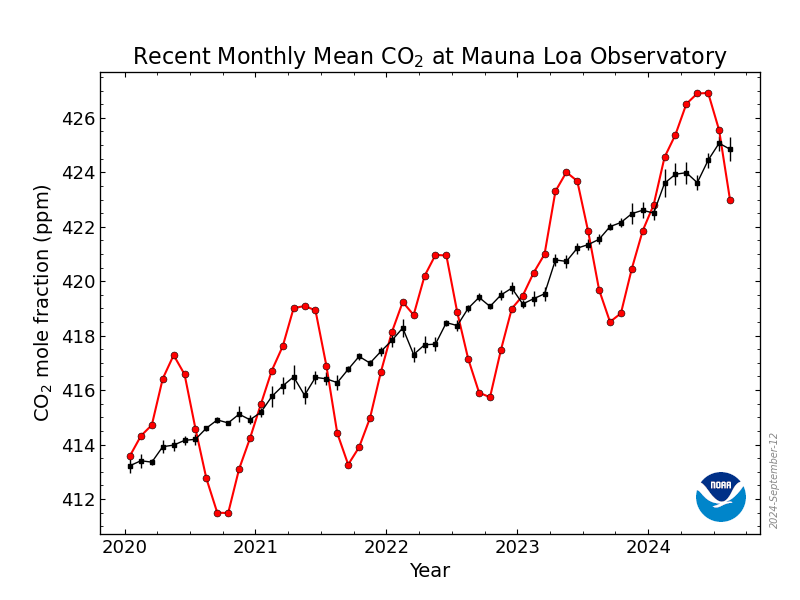
I think the risk is not as high as a lot of people say it is with respect to global warming. But I think if you just keep increasing the cost per million in the atmosphere long enough, eventually it actually simply gets uncomfortable to breathe. People don’t realize this. If you go past a thousand parts per million of CO2, you start getting headaches and nausea. And so we’re now in the sort 400 range. We’re adding, I think about roughly two plus per million per year. So it still gives us… What it means is we still have quite a bit of time, so it’s not like we don’t need to rush and we don’t need to stop farmers from farming or prevent people from having steaks or-
Donald Trump (01:08:08):
Right. Right.
Elon Musk (01:08:08):
… basic stuff like that. Leave the farmers alone.
…
He’s citing HVAC figures (I expect a consultant informed him of the 1,000 ppm guideline.) I’ve worked in a building where CO₂ levels got to be in excess of 1,000 ppm. We were all falling asleep at our desks.
If atmospheric CO₂ levels get to 1000 ppm, being increasingly stupid won’t be our biggest problem.