Environment & Energy
Related: About this forumNicotine Derived Ionic Liquids For the Removal of Water from Gas Streams.
The paper I'll discuss in this post is this one: Water Vapor Separation from Gas Streams Using Nicotine-Based Ionic-Liquid Membranes Dionysios Vroulias, Athanassios Chrissanthopoulos, Vassileios Dracopoulos, and Theophilos Ioannides Industrial & Engineering Chemistry Research 2026 65 (17), 8976-8989.
In this space, I often refer to a paper that I think should guide all sustainable energy ideas - based on the only sustainable form of primary energy there is, nuclear energy - written by the late great Nobel Laureate George Olah, one of Martians who came to the United States back in the days that the United States was believed to be a good place to live. (Today more people are leaving the United States than are coming here, the reason being the Orange Pedophile in the partially destroyed White House.)
The paper refers to closing the industrial carbon cycle, this one: Anthropogenic Chemical Carbon Cycle for a Sustainable Future George A. Olah, G. K. Surya Prakash, and Alain Goeppert Journal of the American Chemical Society 2011 133 (33), 12881-12898
The paper refers to two carbon compounds that might be used as an energy currency - that is to move energy around in liquid form to places it is needed - methanol and dimethyl ether, generally abbreviated as DME.
The basic idea is to avoid the horrible and dangerous physical properties that all of our antinukes like to prattle about in an effort to greenwash fossil fuels, hydrogen, by industrially hydrogenating carbon dioxide, according to the following chemical reactions:
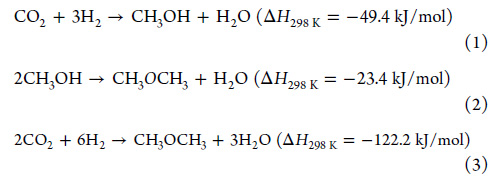
Source: Unravelling Proximity-Driven Synergetic Effect within CIZO–SAPO Bifunctional Catalyst for CO2 Hydrogenation to DME Libo Yao, Xiaochen Shen, Yanbo Pan, and Zhenmeng Peng Energy & Fuels 2020 34 (7), 8635-8643
It is possible under some catalytic systems to eliminate reaction (2) and proceed to reaction (3) directly. Note that for each molecule (mole) of DME formed in this reaction, 3 moles of water are formed.
DME is, unlike hydrogen that all of our antinukes like to hype - is an easily liquifiable gas, it's critical temperature is significantly higher than the boiling point of water, making it very much like the dangerous fossil fuel derived product propane or LPG in use, but the short atmospheric half-life of DME is about 5 days, meaning it has essentially zero climate risk. It is a drop in replacement for methane, ethane, propane, and in fact gasoline and diesel fuel.
One way to separate water from DME is to simply cool the synthesis gas, the boiling point of water 373 Kelvin is much higher than that of DME at atmospheric pressure, 268 Kelvin (-5 oC). Another way is to pressurize the DME/water mixture to liquefy it, allow the heat of vaporization to come to equilibrium with ambient temperatures, remove the DME by evaporation or reduced pressure - DME is an excellent refrigerant - and collect the water as ice. This however would be a rather convoluted and expensive, I imagine process.
DME is made commercially as a replacement for CFCs in spray cans, so I'm sure the water removal issue has been solved on an industrial scale, my speculations off the top of my head not withstanding.
The paper cited at the outset does however strike me as interesting.
From the text:
Structurally, liquid membranes are categorized into three main types: emulsion liquid membranes (ELMs), bulk liquid membranes (BLMs), and supported liquid membranes (SLMs). (9) ELMs often suffer from emulsion instability, while BLMs exhibit low gas permeability due to their considerable thickness. In contrast, SLMs utilize a small volume of liquid phase immobilized within a membrane substrate, resulting in enhanced flux and selectivity due to the chemically stable interface between the liquid and the support material. (10)
Supported ionic liquid membranes (SILMs) represent a specialized form of SLMs, where an ionic liquid (IL) is retained within a microporous polymeric or ceramic substrate by capillary forces. The integration of ILs with membrane-based technology has attracted growing interest due to their favorable properties, including low volatility, high thermal and water stability, nonflammability, and ease of regeneration. (11) Moreover, the solubility of gases and water can be tuned by modifying the cation or selecting an appropriate counteranion. (12,13) Despite their advantages, the practical implementation of SILMs at pilot or industrial scale may be hindered by issues such as liquid loss and limited stability under real operating conditions. Nevertheless, recent studies using [EMIM][Tf2N] supported on porous PAN membranes for CO2 separation have demonstrated promising operational stability. (14) These membranes were operated under a transmembrane pressure of 3 bar for over 335 h using actual flue gases from a lignite-fired and a coal-fired power plant in Germany.
To date, only a limited number of studies have explored the use of supported IL membranes for gas dehumidification. Sullivan-González et al. reported that previously published permeation values may have been underestimated due to boundary layer resistances. (15−17) Therefore, the more recent data from their work should be used when comparing the H2O/CH4 separation factors of SILMs...
...Nicotine, an alkaloid naturally found in tobacco plants, has garnered increasing attention as a precursor for the synthesis of ILs. While nicotine-derived ILs have traditionally been investigated for their catalytic activity and roles in organic transformations, their potential in separation science has only recently begun to receive attention. (21−23) To date, most research has focused on cationic modifications in nicotine-based ILs, whereas the influence of the counteranion on separation performance remains comparatively underexplored. (24) Variations in the cation structure, such as alkyl chain length and ether substitution, significantly affect water vapor transport, with [MOEtOEtNic][TFSI] demonstrating promising results for dehumidification applications.
The present study addresses this gap by systematically investigating the effect of anion hydrophilicity on the transport properties and separation efficiency of nicotine-based ILs...
Ionic liquids are organic salts composed of two charged organic species, one positively charged (in this case a nicotine derivative) and a negatively charged organic molecule, that have very low vapor pressures.
The structures in this paper, referring to the ionic liquid structurally in this case are given in scheme 1 from the paper:
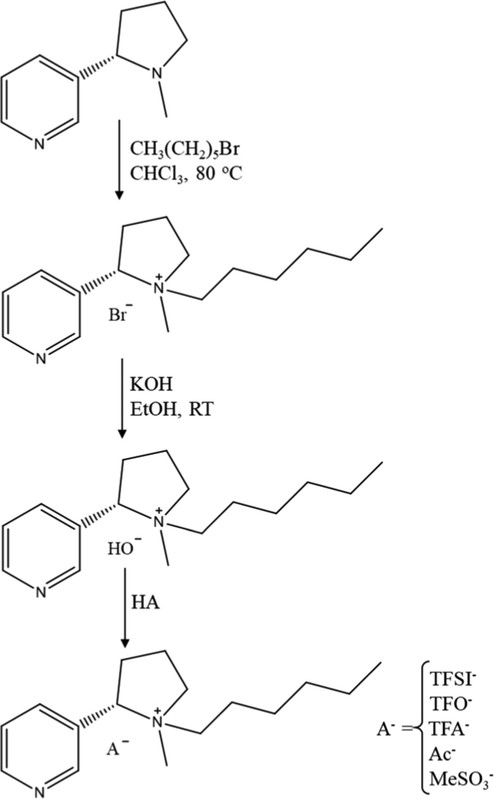
The authors settle on the hexyl alkylated species for the cation and then explore various anions. A figure is given comparing the various counterions for selectivity:
The caption:
The ionic liquids are characterized by thermal analytical procedures, DSC, (differential scanning calorimetry) and TGA (thermogravimentric analysis) to determine melting points (glass transitions in this case) and stability:
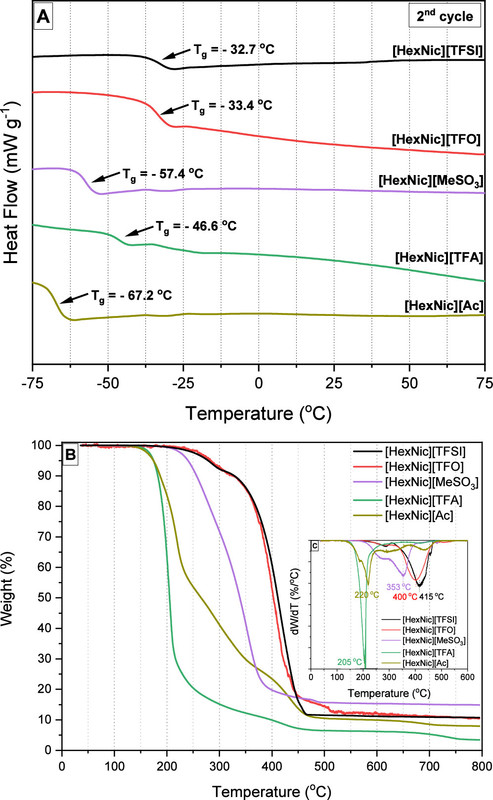
The caption:
The selectivity for water is evaluated:
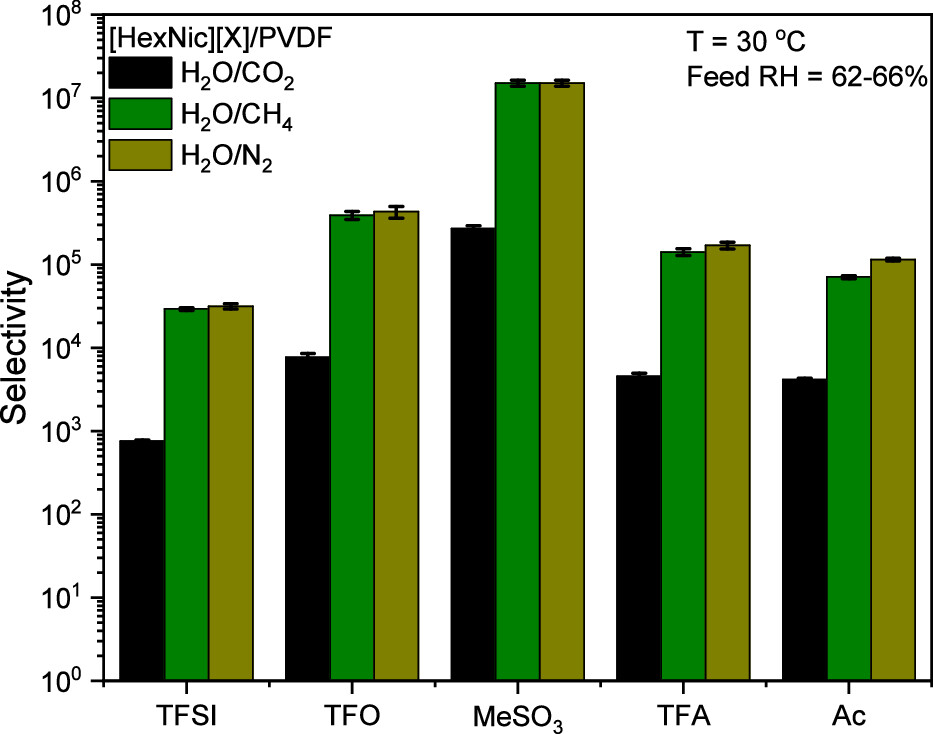
Note that in this case, none of the gases are DME; however presumably the system might be adjusted for this gas after the synthesis gas is cooled - the formation of DME from hydrogen and carbon dioxide is exothermic - and the removal of residual water by an IL would be a "polishing" step.
The paper discusses a variety of physical properties of the system which are fairly technical and of little consequence in this forum. I point to it not as a "ready for prime time" industrial system, but rather as a lab scale system indicating a trend.
It's a cool idea, and one I've not thought about in my musing on the DME system.
Some remarks from the paper's conclusion:
Supported IL membranes were synthesized using a hydrophobic PVDF support, and their gas and water vapor performance was investigated. Gas permeability increases with the increasing size of the anion as well as the number of fluorine atoms it contains. In addition, gas transport of acetate ILs is mainly affected by their rheological characteristics; [HexNic][TFA] exhibits lower viscosity compared to the rest of the ILs, and [HexNic][Ac] is a non-Newtonian pseudoplastic liquid, forming IL aggregates. Regarding water vapor permeability, it can be adjusted by selecting counteranions with high hydrophilicity. Thus, [HexNic][MeSO3] membrane exhibited the highest water vapor permeability of 8 × 10⁵ barrer with a H2O/CH4 selectivity of 1.5 × 10⁷.
The supporting polymer is a fluoropolymer, something I always regard with suspicion, whether it's in the context of hydrogen fuel cells which all of our antinukes like to hype in their grotesque ignorance of physics and the actual "greenery" of hydrogen (which doesn't exist on any meaningful scale by the way), or elsewhere. Again, the paper is not definitive for the DME case, but merely indicative of a potentially promising direction.
These sorts of things might well be managed in a heat network with heat flows originating in the high temperatures of nuclear fuels.
I trust you're having a pleasant start to the Memorial Day Weekend.
 = new reply since forum marked as read
Highlight:
NoneDon't highlight anything
5 newestHighlight 5 most recent replies
= new reply since forum marked as read
Highlight:
NoneDon't highlight anything
5 newestHighlight 5 most recent replies

GreatGazoo
(4,727 posts)Tobacco?

NNadir
(38,588 posts)...application, it is not a particularly difficult molecule to synthesize industrially.