2026-05-08
A joint research team from Nitto Boseki Co., Ltd. (Nittobo) and Tohoku University has revealed that Poly(ionic liquid)s (PILs) can achieve high carbon dioxide (CO₂
) adsorption when their counter anions are exchanged. This discovery provides a critical new design guideline for the development of high-performance CO₂ recovery devices and gas separation membranes.
…
The joint research team--which also includes Kazuhiko Igarashi, Senior Technical Supervising SV at Nittobo--successfully removed inorganic salts by precisely purifying the PILs. They discovered that increasing the size of the counter anion significantly improves the CO₂ adsorption capacity. Notably, the material using the largest anion achieved an adsorption capacity seven times greater than the raw material.
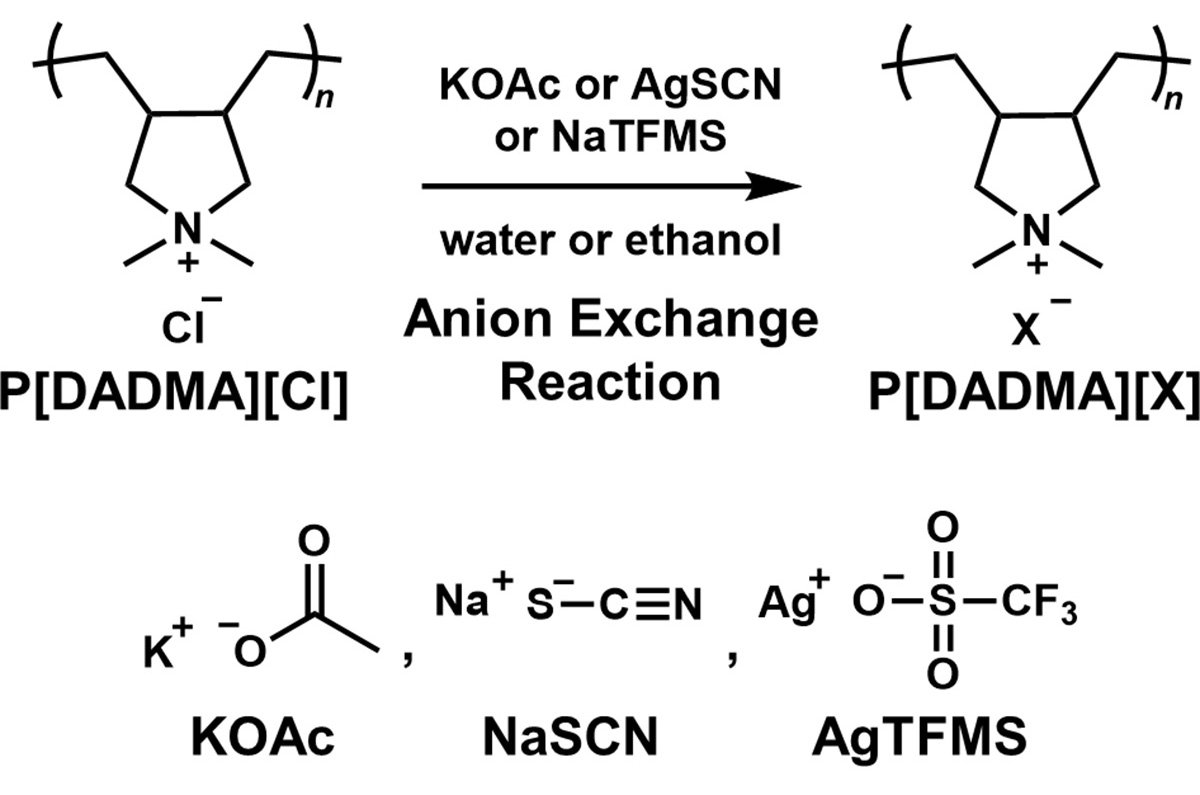
Synthesis of PILs based on P[DADMA][Cl]. ©Kouki Oka et al.
Developing efficient ways to capture and separate CO₂ from the atmosphere and industrial emissions is an urgent challenge in addressing global warming. PILs are considered promising materials for this purpose because they combine the high CO₂ affinity of ionic liquids with the stability and ease of processing of polymers. In particular, PILs with a quaternary ammonium structure are known to perform well. However, until now, the effects of residual metal ions from inorganic salts formed during synthesis have not been fully studied.
In this work, the researchers focused on poly(diallyldimethylammonium chloride) (P[DADMA][Cl]
), a material with a high density of positive charges. They replaced the chloride (Cl⁻
) ion with three anions of different sizes--acetate (AcO⁻
), thiocyanate (SCN⁻
), and trifluoromethanesulfonate (TFMS⁻
)--to examine how anion size affects CO₂ adsorption.
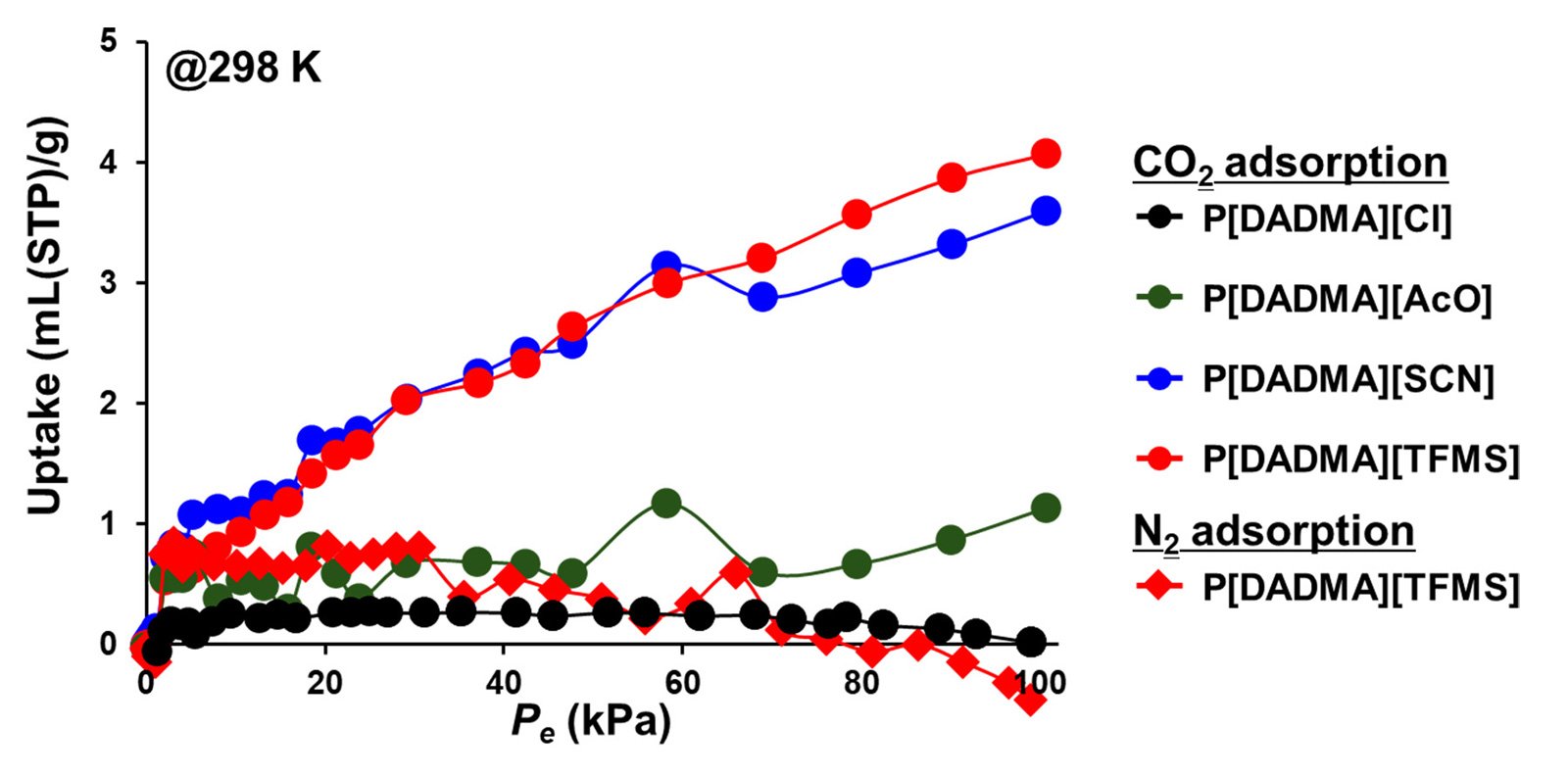
CO₂ and N₂ adsorption isotherms of P[DADMA][Cl] (black), P[DADMA][AcO] (green), P[DADMA][TFMS] (red), measured at 298 K. ©Kouki Oka et al.
…
This research has established a new performance-enhancing approach of "precisely designing the anion size" for PILs. The findings are expected to contribute significantly to the future enhancement of CO₂ capture systems and gas separation membranes.
…
Okubo, K.
Anion size-dependent carbon dioxide adsorption capacity in high-purity diallyldimethylammonium-based poly(ionic liquid)s.
