Tracking the Pollution Exposure of an Ecosystem by Applying Nuclear Bomb Testing Debris.
The paper I'll discuss in this post is this one: Temporal Evolution and Origin of Radionuclide Fallout and Contaminants Recorded in Sediment from the Kerguelen Archipelago Fjord System Yangjunjie Xu-Yang, Olivier Evrard, Anthony Foucher, Pierre-Alexis Chaboche, Irène Lefèvre, Nirina Taraconat, Judith Kobler, Christine Alewell, Silke Merchel, Peter Steier, Elisabeth Michel, Thomas Thiebault, Emmanuel Chapron, Léo Chassiot, and Sophie Ayrault Environmental Science & Technology 2026 60 (8), 6635-6648.
The tenor of this paper is similar to one I wrote many years ago, in 2009, before I was banned at DailyKos for making the true statement, that opposing nuclear energy kills people:
Every Cloud Has A Silver Lining, Even Mushroom Clouds: Cs-137 and Watching the Soil Die.
The argument I used to make the point that got me banned was a harsh succinct restatement of the point made by a paper I frequently cite and link at DU:
Prevented Mortality and Greenhouse Gas Emissions from Historical and Projected Nuclear Power (Pushker A. Kharecha* and James E. Hansen Environ. Sci. Technol., 2013, 47 (9), pp 4889–4895)
I interpreted the paper as a statement that opposing nuclear energy is effectively murder, since opposing nuclear energy kills people. This statement was true in 2009, in 2013, and it is true now.
When I wrote the post in the week beginning March 15, 2009 the concentration of the dangerous fossil fuel waste carbon dioxide was 388.13 ppm. When the famous client scientist James Hansen - who was a hero at Daily Kos until pointed out something they didn't like over there, that nuclear energy saves lives - published the paper officially, the citation of which led to my Daily Kos banning, the concentration of the dangerous fossil fuel waste carbon dioxide in the atmosphere for the week beginning March 10, 2013 was 396.84 ppm. As of the week of March 8, 2026, the concentration was 429.91 ppm.
This data can be found at the Mauna Loa Carbon Dioxide Observatory: Trends in Atmospheric Carbon Dioxide (CO2)
In my 2009 post - I had a habit of making silly polls at Daily Kos - my poll focused on the great anticipation and joy that correspondents at Kos had for getting their hands on a Tesla electric car led by a person widely admired there at the time, some guy named Elon Musk.
Both Elon Musk and Jim Hansen have fallen from grace in Kossian perception.
Over the last ten years, by the way, the world spent close to 5 trillion dollars on so called "renewable energy." This expenditure has had no effect on the degradation of the planetary atmosphere other than to accelerate it.
Anyway. Let's turn to the paper cited at the outset of this post...
From the introduction:
The Southern Ocean (between 40° and 65°S) plays an important role in the autoregulation of the Earth's climate and is the major sink of CO2 on Earth. (1,2) It is known to be the largest high-nitrate low-chlorophyll oceanic area. (3) In this zone, iron (Fe) and other transition elements limit plankton growth and development and thus, the associated CO2 absorption. (4−8) The Southern Ocean has undergone substantial climate changes over the last several decades, resulting in increasing stress for phytoplankton development. (9,10) Anthropogenic disturbance via trace metal inputs to this region also influences the development of phytoplankton, inducing changes in global marine net primary productivity (11,12) and having a substantial influence on the global CO2 sink. (13,14)
Fjord and adjacent coastal ocean ecosystems are hotspots of biogeochemical activity that accumulate and store organic carbon and nutrients, and represent significant organic carbon sinks. (15,16) Fjords are particularly sensitive to climate change. (15,17) Glaciers are exceptionally effective at eroding landscapes (18,19) and generate highly reactive and quickly weathered sediments. (20,21) This sediment therefore provides ideal archives for reconstructing high-resolution records of past glacier variability, which allows for investigating the climate and environmental changes. (15,17,22) The Cook Ice Cap (CIC) of Kerguelen Island, situated in the Southern Indian Ocean (Figure 1), has experienced an extremely negative surface mass balance caused by the occurrence of lower precipitation and higher sea surface temperature since the 1950s, (17,23,24) a trend that has accelerated since the 1990s. (25,26) Future projections anticipate that the CIC will disappear by 2100, which could have progressive and significant impacts on endemic and invasive fauna and flora. (24)
The soothsaying about 2100 and the disappearance of the Cook Icecap flies in the face of the soothsaying of the ignorance squad at Greenpeace, who predict a "renewable energy" nirvana by 2050. There seems to be a difference of opinion about which Ouija board to believe. (It would take a lot of mining, a lot of industrialized wilderness, for the Greenpeace soothsaying to come true. As an environmentalist, I'm not amused.)
The article continues:
Ongoing and future decreases of glacier cover may lead to the release of long-range transported legacy contaminants already deposited and stored in snow and ice. (27−29) To elucidate this phenomenon in the Southern Indian Ocean region, in-depth investigations of long-range transported trace metals and persistent organic pollutants (POPs) in the fjord system of Kerguelen are required. To this end, the collection and dating of sediment archives using naturally occurring and artificial radionuclides (210Pbex, 137Cs, 239Pu, 240Pu) may provide a powerful tool to establish environmental and climatic reconstructions and allow a better understanding of environmental changes, climate forcing, or contamination pressures across the globe. (30−32) The documentation of these artificial radionuclides remains sparse in the Southern Hemisphere (30−32) and 137Cs will become increasingly difficult to measure due to its relatively short half-life (30 years) and its major input in the 1960s, (33) since most of the inputs from the 1960s have already decayed. Furthermore, due to the discontinuous monitoring of the United States Atomic Energy Commission’s Environmental Measurements Laboratory between 1954 and 1976, the contribution of French nuclear weapon tests (1966–1974) to the atmospheric 137Cs has not been investigated in detail. The emissions of 137Cs originating from the French nuclear weapon tests, which peaked in 1968 in the Southern Hemisphere, may have been mistakenly attributed to global fallout. (30,33,34) Nevertheless, 240Pu/239Pu atomic ratios can help to distinguish between global [in 1964–1965, 240Pu/239Pu = 0.18 (30)] and French nuclear weapon tests fallout [1966–1974, 240Pu/239Pu = 0.04 (30)], because of the distinct signatures of these two sources. It is therefore particularly useful to combine the analysis of 137]Cs and 240Pu/239Pu in sediment profiles collected in this region to establish reliable age models.
Kerguelen Archipelago, a part of the French Southern and Antarctic Lands, is a remote island in the Southern Indian Ocean, located far away from the main continents, where most data on artificial radionuclides (137Cs and 240Pu/239Pu) have been provided. (30−33) It is one of the rare accessible land sites where artificial radionuclides can potentially be measured across this wide ocean. Detailed radionuclide measurements and the associated sediment age-depth model are hence essential to improve our understanding of the atmospheric circulation and radionuclide fallout deposition mechanisms in fjord systems of this region. In the current research, we provide complementary radionuclide analyses conducted in a sediment core collected in the Table Fjord situated in the Kerguelen Archipelago to validate and potentially improve the age-depth model established by a previous study. (17) Based on this refined age model, our second objective was to investigate the impact of environmental changes related to glacier retreat on the elemental composition of sediment in the fjord and to reconstruct the time series of contaminant deposition recorded between 1850 and 2006 in the fjord...
This figure shows the concentrations of the radionuclides per kg in the unit Becquerel, which corresponds to one nuclear decay per second:
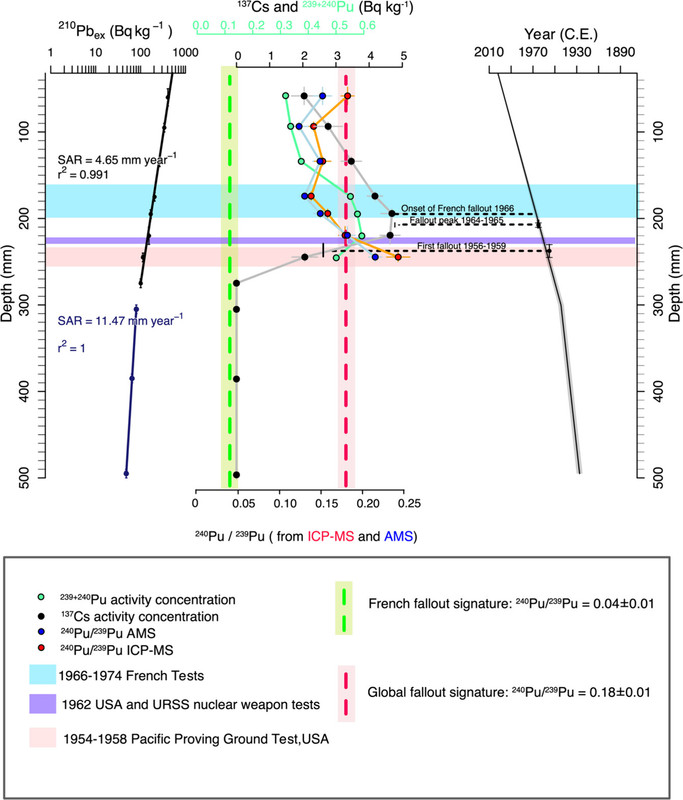
The caption:
Figure 2. Short-lived radionuclide data, and age-depth model established for the Kerguelen Table Fjord sediment core. Left: 210Pbex activity concentration measured by gamma spectroscopy. Middle: 137Cs (black dots) and 239+240Pu (green dots) activity concentrations (measured by gamma spectroscopy and derived from ICP-MS measurement, respectively), and 240Pu/239Pu ratios measured by ICP-MS (red dots) and AMS (blue dots, weight-averaged values under temperature conditions of 80 and 600 °C, see Supporting Information Text S3). Right: 210Pbex depth-age model based on the CFCS model. (17,42) The 240Pu/239Pu signature associated with the French nuclear weapon tests (0.04 ± 0.01 (30)) is depicted by the green dotted vertical line and the green vertical rectangle for uncertainties, while the global signature (0.18 ± 0.01 (30)) is represented by the red dotted vertical line and the pink vertical rectangle for uncertainties. Much of the energy yielded by the Pacific Proving Ground test (1946–1958) was generated between 1954 and 1958 (depicted by the red zone on the figure), while most energy of the French Tests (1964–1974) was yielded between 1966 and 1971 as well as in 1974. Accordingly, the period between 1966 and 1974 is marked in blue. Furthermore, 1962 is the year with the highest energy yielded in human history due to extensive USA and URSS nuclear weapon tests, and this year is indicated in purple. Energy of nuclear weapon was taken from Dicen et al. (33) The first fallout period (1956–1959) detected globally, the maximum global fallout period in the Southern Hemisphere (1964–1965) and the onset of the French fallout period in the Southern Hemisphere (1966), are represented by dotted horizon lines.
The authors use the temporal time markers of the radionuclides to understand the deposition of persistent organic chemicals such as PCBs, PAH's, organochlorines, PBDEs, as well as heavy metals like lead. For the persistent organic contaminants, the concentrations were happily low.
An excerpt of the authors' conclusions:
...Long-range transported legacy and recent contaminants released by human activities have been detected in a sediment core collected in the Kerguelen Archipelago fjord system. The age-depth model based on 210Pbex activities was validated and refined through the combined analysis of 137Cs activities and 240Pu/239Pu atomic ratios measured with depth in the core. This allowed a detailed analysis of the temporal evolution of pollutants released into the fjord system during the last century, in the current context of climate change and increasing human pressures. In the fjord system of Kerguelen Island, the shrinkage of glacier cover induced by climate change is leading to the release of long-range transported anthropogenic legacy lead deposited and stored in snow and ice that accumulated in the past. The delivered anthropogenic Pb may be transported by a hypopycnal flow from melting glacial ice to the fjord system. Lead stable isotope ratios, the analysis of backward trajectories, and a critical literature review on atmospheric models all suggest that South Africa is a major source of anthropogenic Pb and other trace elements transported to these remote regions of the Southern Indian Ocean. Contemporary atmospheric inputs for other trace elements, such as As, Mo, and Sb (via direct atmospheric deposition or runoff) after the onset of ice melting have been observed since 1990 and were shown to follow a different temporal evolution than that of Pb. Persistent organic pollutants (POPs) were also detected in the uppermost layer of the core, suggesting the appearance of long-range transported organic contamination during the most recent period. The current ecological impact of these contaminants likely remains negligible or very low, as their concentrations were minimal. This is ─ to the best of our knowledge ─ the first time that the fallout radionuclide contribution of French Nuclear Weapon tests conducted in French Polynesia is detected and quantified in a sediment core collected on an island of the Southern Indian Ocean...
Have a pleasant evening and a nice day tomorrow.

 = new reply since forum marked as read
Highlight:
NoneDon't highlight anything
5 newestHighlight 5 most recent replies
= new reply since forum marked as read
Highlight:
NoneDon't highlight anything
5 newestHighlight 5 most recent replies
