Environment & Energy
Related: About this forumHow U.S. states can attract fusion power plants: A new CFS white paper
https://blog.cfs.energy/five-ways-us-states-can-attract-fusion-power-plants/…
But what if you want safe, clean fusion energy to come not just to the world, but to your state? Our experience might help you out. This post offers a quick look at what’s important, but we’ve also published a white paper on U.S. state actions to attract commercial fusion development. You can download it here or read the embedded version below.
…
We expect our first ARC fusion power plant will start putting watts on the grid in Chesterfield County, Virginia, in the early 2030s. Here at CFS, we’re often asked about the right policies states can implement to attract the fusion industry and tap into the benefits that fusion energy promises. We know firsthand what can be encouraging and what can be a deterrent to companies like us that are developing fusion power plants in the coming years.
A global race for fusion is shaping up: there are now 53 fusion energy companies around the world that have raised over $10 billion in capital. With more than half of the fusion industry located in the U.S., states have a unique opportunity to lead the way in deploying this new energy source within their borders. Ultimately, leading in fusion energy will mean leading in economic development opportunities and clean energy technology.
Becoming the leader in commercial fusion power takes a willingness to be innovative with policy. While we acknowledge each state is different, the following high level policy ideas are a starting point for consideration for states wanting to attract private fusion companies such as CFS and wanting to be at the forefront of clean, firm, dispatchable, and affordable energy. As CFS works to bring fusion power to the grid, we appreciate the chance to talk and partner with states to explore how to adopt innovative policy structures to support fusion power generation development.
…
—
FWIW: Commonwealth Fusion Systems, a spin-off from MIT is working on a much smaller “tokomak” reactor design than ITER, made possible by new “high temperature” superconducting (HTS) magnets. They’re currently working on a demonstration reactor, called SPARC, expected to produce "net energy.” — “Q>1” in 2027.
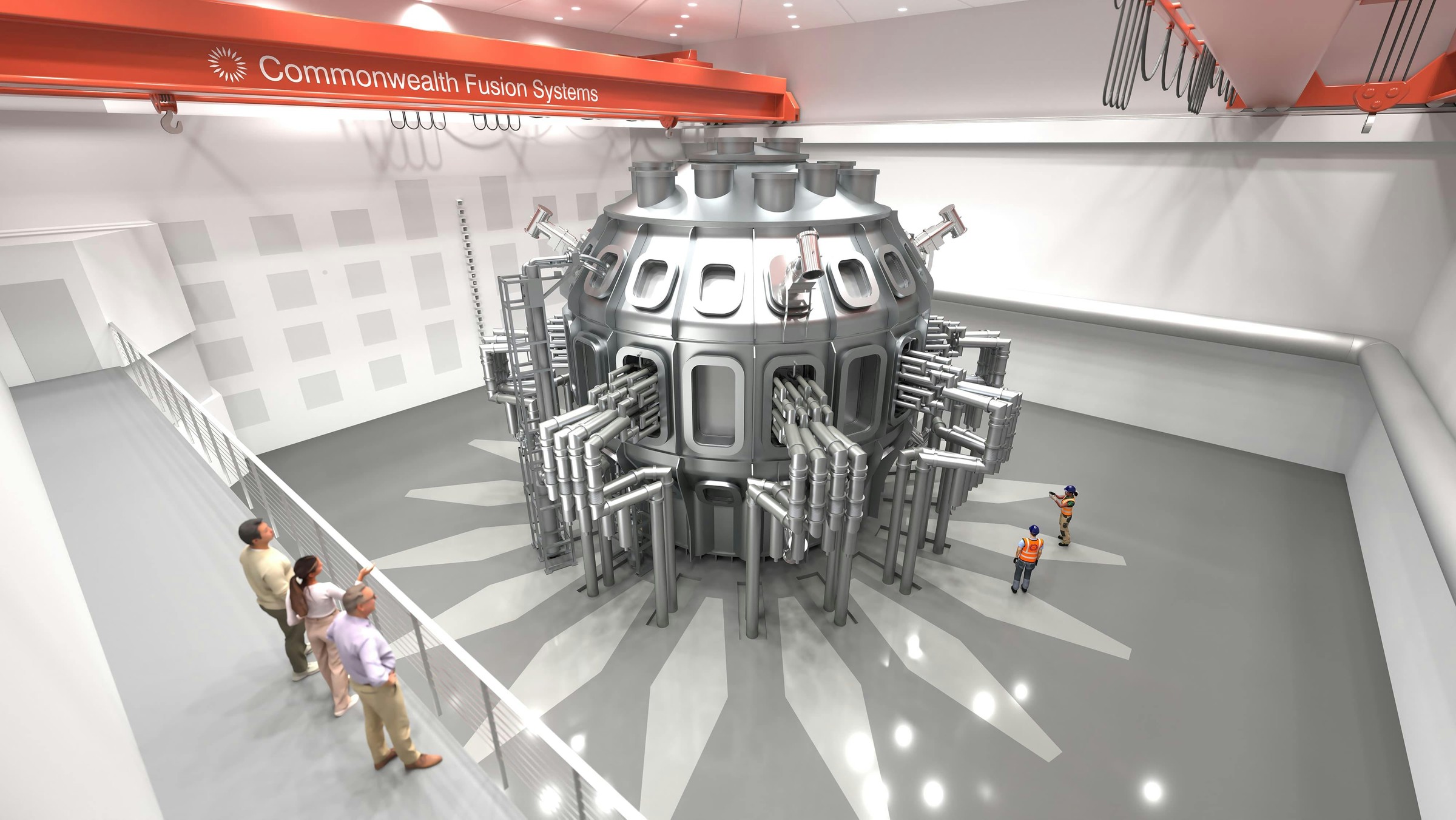
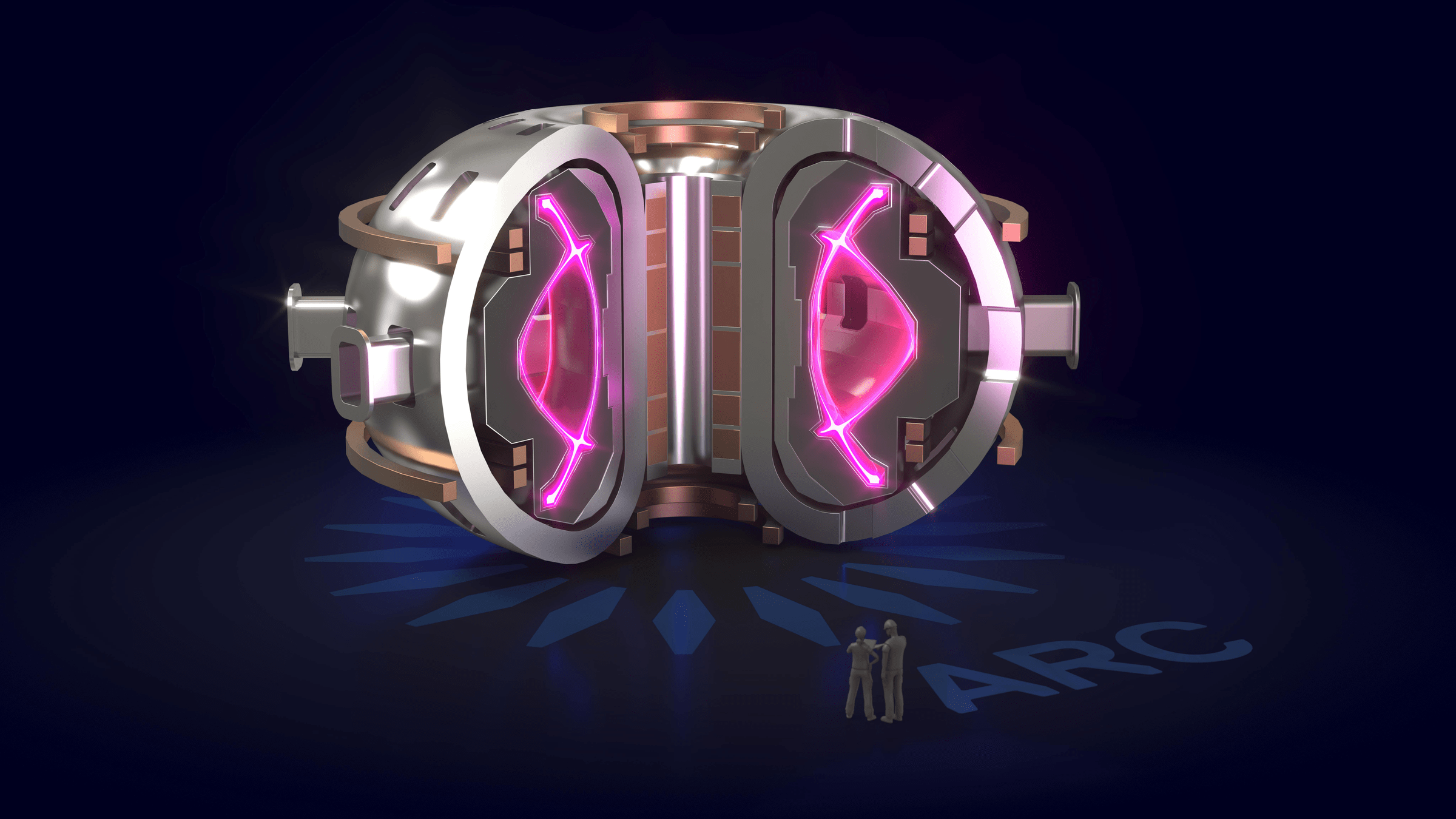
The plan is to quickly follow SPARC with a commercial reactor ARC (mentioned above) a plant intended to produce “net electricity” something no fusion reactor has accomplished to date.
ARC is designed to be commercial, incorporating market feedback so it’ll slot seamlessly into the power grid. It checks all the boxes for the electricity generation market: a firm supply of clean, safe, and affordable energy that works for dispatchable or baseload demand, all from a facility that can be built just about anywhere. And we're talking to customers now who want to sign up for its power.
ARC will be flexible and familiar. To the grid, it’ll look just like the 2,000 natural gas plants already built in the US — except that ARC won’t release any carbon dioxide or other greenhouse gases. Operators will be able to ramp ARC’s power output up and down faster than possible with most fossil plants, making it easy to integrate with renewable resources and adapt to grid or market changes. More likely, ARC will supply steady baseload power that’s increasingly needed to support new critical infrastructure and replace fossil fuel plants.
…
ARC will be safe. Unlike nuclear fission plants, fusion energy has no chance of runaway chain reactions or meltdowns, and there’s no long-lived or high-level nuclear waste. US regulations treat fusion power plants similarly to how they treat particle accelerators, not nuclear fission plants — an approach that recognizes fusion’s inherent safety and supports its rapid scaling.
…
ARC fuel will be abundant, ubiquitous, and cheap. The fusion process heats two forms of hydrogen, deuterium and tritium, into a highly energetic plasma — a cloud of particles that fuse and release energy. A liquid “blanket” captures that energy as heat, then transfers it to water that turns a steam turbine to generate power. Deuterium is available nearly everywhere and can be filtered from seawater, while ARC blankets will naturally produce tritium. And because only small amounts are needed, 30 years of ARC fuel can be delivered by a single truck when a new plant opens, with no price change risks down the line and no linkages to globally fraught supply chains. With fusion fuel costs forecast to become effectively negligible, volatile power prices driven by fluctuations in natural gas prices will be a thing of the past.
…
 = new reply since forum marked as read
Highlight:
NoneDon't highlight anything
5 newestHighlight 5 most recent replies
= new reply since forum marked as read
Highlight:
NoneDon't highlight anything
5 newestHighlight 5 most recent replies

hatrack
(64,771 posts)

OKIsItJustMe
(21,790 posts)This spin-off comes out of a half-century old research program at MIT.
https://www.psfc.mit.edu/about/
The PSFC's genesis
In the early 1970s, a collaboration between MIT’s Francis Bitter Magnet Lab (FBML) and a group of researchers in various MIT departments led to the first magnetic confinement tokamak experiment housed on campus, called Alcator. At the time, it was the highest field magnetic confinement device in the world. Success of that program and a growing national interest in fusion energy provided the initial impetus for the formation of the Plasma Science and Fusion Center (then called the Plasma Fusion Center).
Officially founded in 1976, the PSFC became a home for the plasma physics and fusion research conducted across MIT, in the FBML, and at the Research Lab for Electronics. Ever since, the Center has attracted leading experts from MIT and around the world to teach, conduct science, collaborate, and study.
…
It happened, because they believed they were ready to produce a commercial product. So, far things are progressing as planned:

FadedMullet
(878 posts)OKIsItJustMe
(21,790 posts)… I’m afraid it’s probably a decade (or two) too late.
FadedMullet
(878 posts)OKIsItJustMe
(21,790 posts)It has all of the capacity we need to replace our current grid, and support the AI farms being built, as well as the damned cryptocurrency “mining" operations… the whole shootin’ match.
Currently, generating electricity is responsible for roughly ¼ of our greenhouse gas emissions…
OK, so, EV’s, another snap of our fingers, and everybody switches to electric (or hydrogen) powered vehicles. Every car, every bus, every train, every plane, every ship that sails the seas. That covers (roughly) another ¼.
hatrack
(64,771 posts)"Fusion, the power source of the sun, is coming to Earth as a disruptive new energy technology." Mkay . . .
"We fervently believe . . . " Yes and I can fervently believe that Quaker State 10W40 is the blood of Christ, that Hitler is living in Brazil, or that Taco Bell sells "food". The fervor of my beliefs has nothing to do with their validity.
"We expect our first ARC fusion power plant will start putting watts on the grid in Chesterfield County, Virginia, in the early 2030s." If it pans out, I'll be happy to applaud accordingly. However, for now it's a self-driving Tesla (flying or otherwise), the Metaverse or New Coke, until proven otherwise.
"A global race for fusion is shaping up: there are now 53 fusion energy companies around the world that have raised over $10 billion in capital." So, $10 billion divided by 53 = +/- $189 million per company. Vogtle 3 and 4 together cost more than $30 billion for two light water fission reactors. Will these 53 companies pool their resources to strain towards a total of (roughly) two orders of magnitude X 0.5 less in funding than that needed to complete two fission units?
Look, I'd be happy to see this succeed, but there's a lot of techno-hopium currently under deployment across multiple technologies and scientific disciplines (geoengineering, AI, autonomous vehicles), and my first reaction to bold announcements like this is skepticism. Sorry if that makes me a "naysayer", but skepticism is more necessary than ever these days, IMO.

NNadir
(37,904 posts)I would think it would only take a modicum of intelligence to suggest that 50 years at MIT is less impressive than 75 years at a national lab where the fusion chimera has been chased as a primary focus, happily with some useful side products connected with the study of plasmas, but no usable energy to perform thermodynamic work.
It is easy to raise money with hype, much more difficult to deliver on the claims of the hype.
But then again, antinukes and "I'm not an antinuke" antinukes have a rather spectacular inability to understand what is real and what is not.
If one has ever attended a serious "fusion will save us" lecture by serious scientists - I've attended scores of them at PPPL - one can immediately recognize that they have only a very vague conception of how to withdraw exergy from the fusion reaction. At a recent lecture, during Q&A, I asked how long a fusion reactor has continuously run. The answer was less than an hour.
But let's bet the planetary atmosphere on it.
It would be interesting if rather than unicorns and hype and of course, so called "renewable energy" the "I'm not an antinuke" antinukes around here would recognize that for the last 70 years, nuclear fission has a spectacular record of producing clean energy more reliably and more safely than any other form of primary energy.
There is no evidence, none, that a fusion plant can run for more than a few hours, nor is there enough tritium on the planet to run a power plant for more than a few weeks with fusion. In fact, there's about 50 kg of the stuff, and the ITER experiment in France, if it even runs, will eat all of it in a few weeks or months of operations.
OKIsItJustMe
(21,790 posts)Does that make Edison’s technology preferable/superior?
NNadir
(37,904 posts)He really was precocious.
It is a sad reality that there are people on this planet who can't tell the difference between combustion and nuclear fusion.
We don't need fusion. We have fission, which works spectacularly well.
OKIsItJustMe
(21,790 posts)
bucolic_frolic
(54,911 posts)IOW, nothing will be remaining when it all plays out
lonely bird
(2,908 posts)What is their process for maintaining plasma at its extremely high temperature?
OKIsItJustMe
(21,790 posts)So, that part is easy (assuming you can contain it.)
lonely bird
(2,908 posts)The heat generated is one thing. The generation of the heat as well as containing it which you noted for the reaction to take place is something else.
OKIsItJustMe
(21,790 posts)What sets this design apart from the multiple “tokamak" reactors MIT has made in the lab is the (relatively) small magnets made with “High-temperature” superconducting tape. They are what contain the hot plasma. (Check out the short video, above.)
https://www.democraticunderground.com/?com=view_post&forum=1127&pid=188214