Organized Labor Took a Huge Step Forward When GM Workers Sat Down in Unison in 1937
Instead of picketing, striking autoworkers in Flint, Michigan, tried a bold tactic that gummed up the works and forced the company to recognize their union
Luke Savage - Author, The Dead Center: Reflections on Liberalism and Democracy After the End of History
March 2026
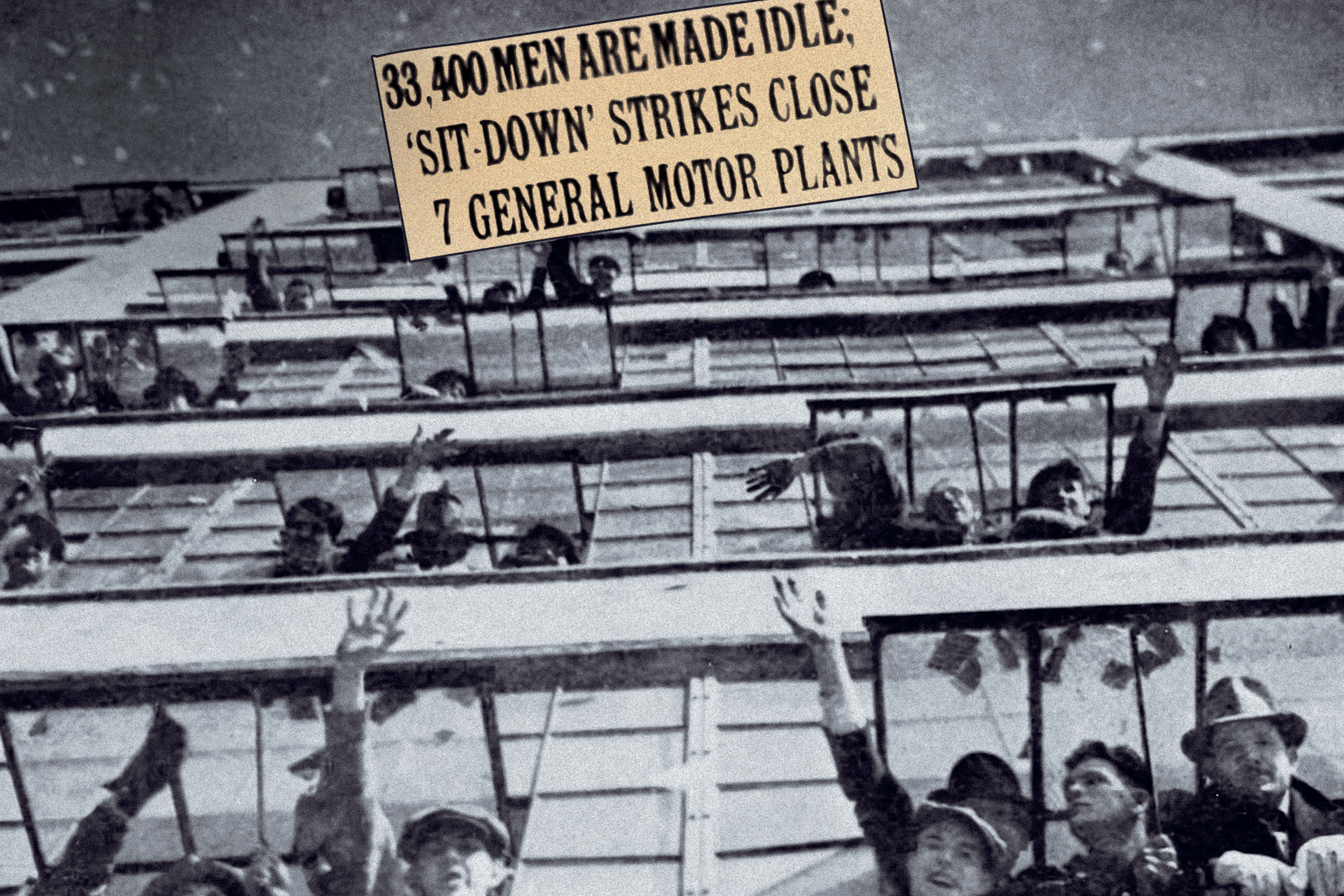
Workers wave proudly from the windows of a plant closed by the sit-down strike in Flint, Michigan, in 1937. Walter P. Reuther Library, Archives of Labor and Urban Affairs, Wayne State University
As the clocks struck noon on January 11, 1937, roughly 100 men camped on the second floor of a Flint auto plant suddenly found themselves without heat. Under normal circumstances, there might have been 1,000 workers inside the Fisher No. 2 facility, bustling to produce auto bodies, sending 450 of them to a Chevrolet assembly facility across the road every 24 hours. But the day’s more austere climate owed itself to decidedly unusual circumstances.
On December 30, the men inside the plant had joined fellow workers in a daring strike action with the aim of forcing a reluctant General Motors to recognize their union, the United Auto Workers (UAW). Eschewing the traditional method of picketing outside, their primary chosen tactic—the sit-down strike—was as disruptive as it was rare. As Greg Zipes, an attorney who teaches at New York University’s School of Professional Studies, has written: “Workers stay at their workstations” to “prevent any other workers, presumably non-union strikebreakers, from taking their place.” Because the processes involved in automobile production were so tightly integrated, relatively small numbers of workers placed at strategically chosen choke points could effectively paralyze production even at an industrial leviathan like G.M.
Since the sit-down had begun, the thousands of strikers had passed the time in relative peace, undisturbed by G.M. management and the police. But, feeling a sudden burst of winter air at midday, the workers realized something was afoot. Sure enough, the company had switched off the heat, and company guards outside were also blocking the delivery of food, marking the first in a series of escalations that culminated in a violent clash that night.
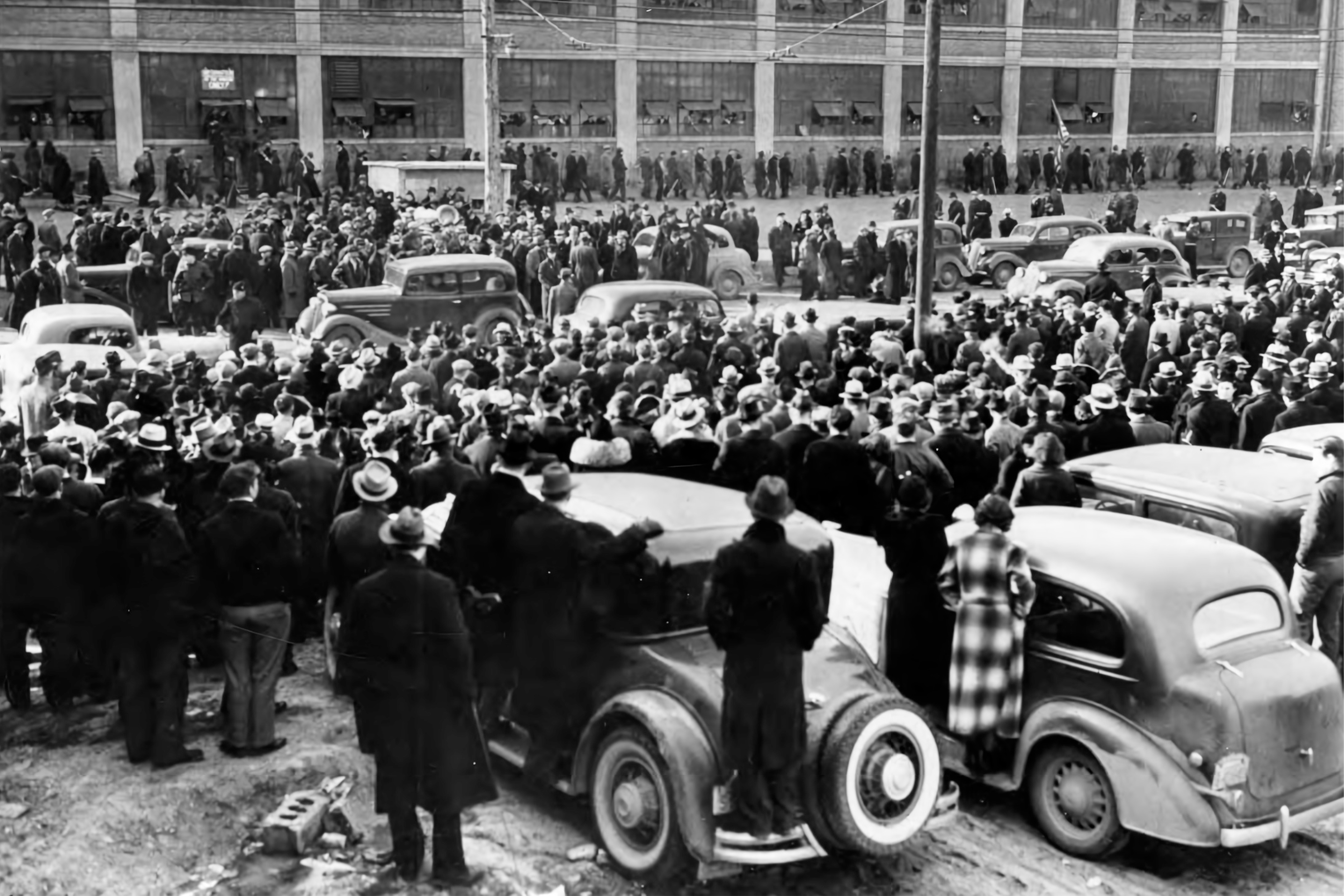
Crowds hail strikers at Fisher No. 1. Some supporters brought meals in giant kettles and huge milk cans; workers often hoisted the food up through windows. Walter P. Reuther Library, Archives of Labor and Urban Affairs, Wayne State University
When police arrived to relieve the beleaguered guards, they began hurling tear gas and eventually fired bullets and buckshot at the strikers. The workers replied in kind with water from fire hoses and ad hoc projectiles. “It was like a war or revolution,” a union photographer who witnessed the melee recalled, “with broken glass and lumps of coal and hinges from Chevrolets.” At least nine police and 14 strikers were injured; most of the latter suffered bullet wounds.
More:
https://www.smithsonianmag.com/history/organized-labor-took-huge-step-forward-when-GM-workers-sat-down-unison-1937-180988089/
 = new reply since forum marked as read
Highlight:
NoneDon't highlight anything
5 newestHighlight 5 most recent replies
= new reply since forum marked as read
Highlight:
NoneDon't highlight anything
5 newestHighlight 5 most recent replies

appalachiablue
(44,174 posts)
Judi Lynn
(164,164 posts)The first times I read about him, the subject was Detroit, and that was a long time ago!
So unbelievably few people are aware of the horrendous level of violence employed by corporations against workers in their desperate, and courageous struggle to improve the monstrous conditions they were thrown into simply trying to earn enough money to keep themselves and their loved ones alive.
~ ~ ~
It's no wonder there are people who fall asleep at their desks in history classes when you realize all the actual information was removed long ago! Whitewashed beyond any resemblance to real events which happened on this planet!
Even as late as George W Bush's Presidency, Lynne Cheney, Vice President Cheney's wife, felt she had to write a new version of U.S. History, to try to explain to children what "American" history really was.

appalachiablue
(44,174 posts)during workers' brave struggle for better treatment amid violent clashes with authorities. US labor history was never even mentioned in public school or college classes when I was a student which is a real shame. Good for Lynn Cheney in recognizing how real American history should be taught. I wonder if the Smithsonian Museum of American History has features or exhibits on labor history. I hope so. Thanks again for posting this article with links to related others. Power to the People.
- Flint Sit Down Strike.. Other notable participants in the sit-down strike were future D-Day hero and Greco-Roman wrestling champion Dean Rockwell, labor leader and future UAW president Walter Reuther, and the uncle of documentary filmmaker Michael Moore, whose debut feature Roger & Me contains a clip from the strike...
https://en.wikipedia.org/wiki/Flint_sit-down_strike