NOAA predicts below-normal hurricane season amid building El Nio
Source: The Hill
05/21/26 8:21 PM ET
The National Oceanic and Atmospheric Administration (NOAA) on Thursday predicted that the upcoming Atlantic hurricane season could be below normal as El Niño intensifies amid its development.
NOAA’s outlook predicts a 55 percent chance of a below-normal season, with between eight and 14 named storms likely to develop. Between three and six of those storms should develop into hurricanes, including one or three that become category 3, 4, or 5 major hurricanes. Hurricane season starts June 1 and lasts until Nov. 30.
El Niño, the weather pattern where water temperatures near the equator of the central and eastern Pacific Ocean rise above the historic average for months at a time, will develop and intensify. These conditions typically support fewer tropical storms and hurricanes, with warmer water temperatures and low winds possibly leading to a more active season in 2027.
“Although El Niño’s impact in the Atlantic Basin can often suppress hurricane development, there is still uncertainty in how each season will unfold,” NOAA’s National Weather Service Director Ken Graham said in a report. “That is why it’s essential to review your hurricane preparedness plan now. It only takes one storm to make for a very bad season.”
Read more: https://thehill.com/policy/energy-environment/5890522-noaa-predicts-below-normal-hurricane-season/
NOAA/NCEP Climate Peediction Center (CPC) most recent REPORT - EL NIÑO/SOUTHERN OSCILLATION (ENSO) DIAGNOSTIC DISCUSSION
CLIMATE PREDICTION CENTER/NCEP/NWS
14 May 2026
ENSO Alert System Status: El Niño Watch
 = new reply since forum marked as read
Highlight:
NoneDon't highlight anything
5 newestHighlight 5 most recent replies
= new reply since forum marked as read
Highlight:
NoneDon't highlight anything
5 newestHighlight 5 most recent replies

WestMichRad
(3,586 posts)Last year’s forecast was for an above-average number of hurricanes etc., but it didn’t turn out that way. Unless perhaps you count all the fish storms that stayed offshore.
So, maybe they are right… but maybe not. And it only takes one tragically placed devastating storm to make it a bad hurricane year.

BumRushDaShow
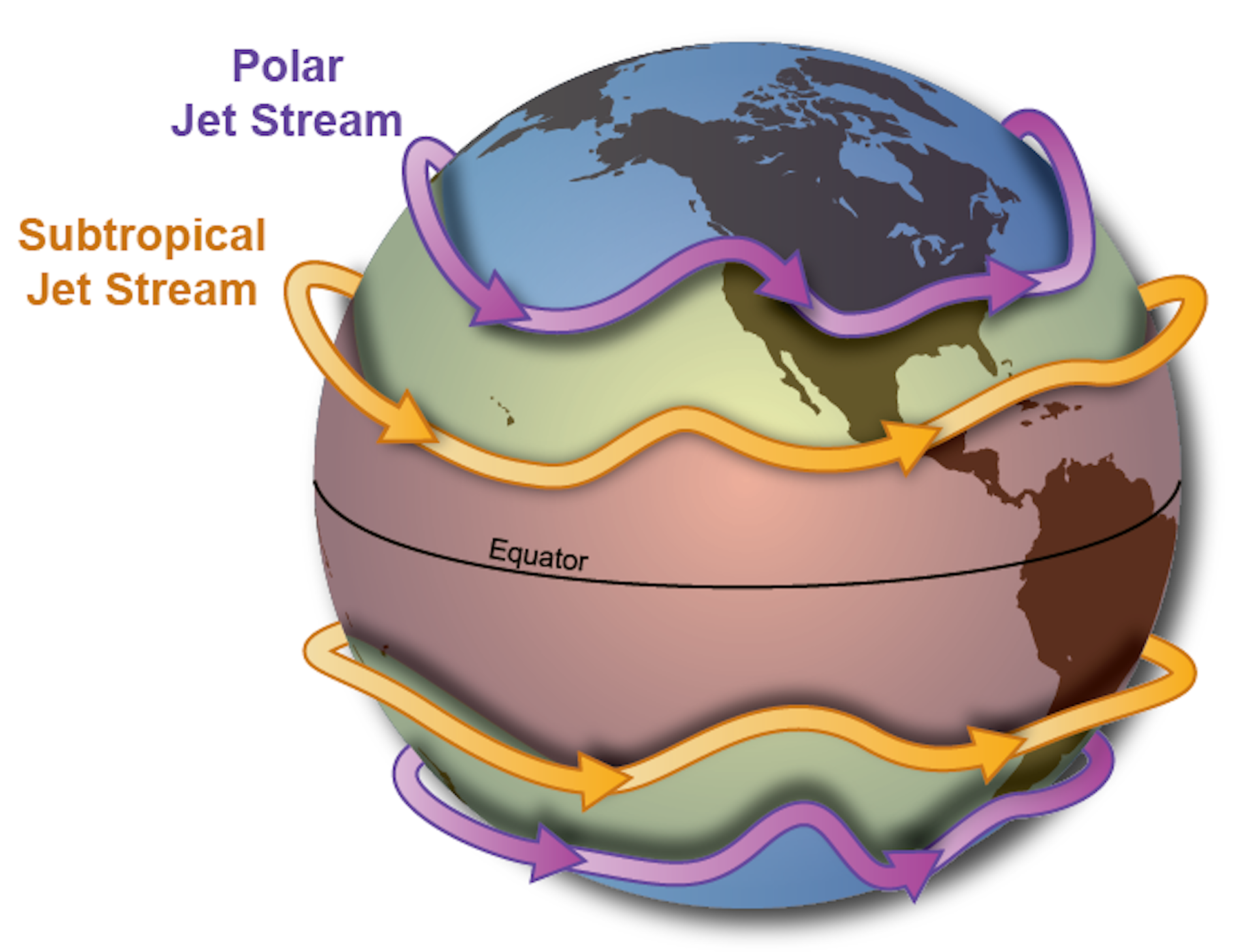
(174,540 posts)The 2024 - 2025 season featured a weak Nina so the shearing was definitely going on with a stronger than usual STJ that pushed storms away from the coasts along with dips in the Polar jet that continued to steer the storms away.

Anything that scooted below the STJ was able to get further west (like the one that hit Jamaica last year) before it got caught up in it.
This actually has a good description of what happened - https://www.wric.com/news/2025s-extreme-weather-had-the-jet-streams-fingerprints-all-over-it-from-flash-floods-to-hurricanes/
WestMichRad
(3,586 posts)… for the informative maps and link. I greatly appreciate your posts.

BumRushDaShow
(174,540 posts)It's one of my oldest hobbies and I literally almost majored in it in college but decided to go with chemistry as that field had a much better chance at getting a job. 
WestMichRad
(3,586 posts)I went from forestry to biology then to chemistry… basically for the same reason. Turns out, my chem advisor was right.
DemocracyForever
(464 posts)because of our warming planet and at a faster rate than the land is warming. Warmer air holds more moisture. This is what's supercharging both hurricanes and typical rainstorms. NYC just got flooded because of such a rainstorm. I no longer trust any NOAA forecasts because the odds that the forecasting is being done by actual climate scientists rather than a no science Trump stooge are pretty low.
BumRushDaShow
(174,540 posts)DemocracyForever
(464 posts)Basic science teaches that warmer air holds more moisture. The oceans are warming and this warmer air is supercharging the storms that are now happening. It just happened with the historic flooding in NYC. I don't have any faith in NOAA. The predictions are likely being made by Trump climate change deniers.
BumRushDaShow
(174,540 posts)I had to take all those physics courses that describe the phenomena.
And as a weather hobbyist for over 55 years, and one who tracks the annual Atlantic hurricanes (I sub to a couple of weather model sites like Pivotal Weather), I have seen the uptick of record breaking RI (rapid intensification) of recent hurricanes in the past 10 years, and it's pretty scary. 
DemocracyForever
(464 posts)when he was in the military. Knowing a lot about the weather was crucial for my engineer father with his more than 40 years of flying experience. The warming oceans are causing hurricanes to be more frequent, larger and much more intense. It used to be that hurricanes broke apart once they hit land. Ashville North Carolina in 2024 is the latest example of that no longer happening. Before 2024, Ashville was thought to be a safe place for escaping the worst of climate change. That's no longer the case.
BumRushDaShow
(174,540 posts)I frequently go to the Recon section of the Tropical Tidbits site to watch their flight tracking and dropsonde data - https://www.tropicaltidbits.com/recon/ (not active for the season yet). E.g., they display this type of OBS info for both NOAA and Air Force recon flights -
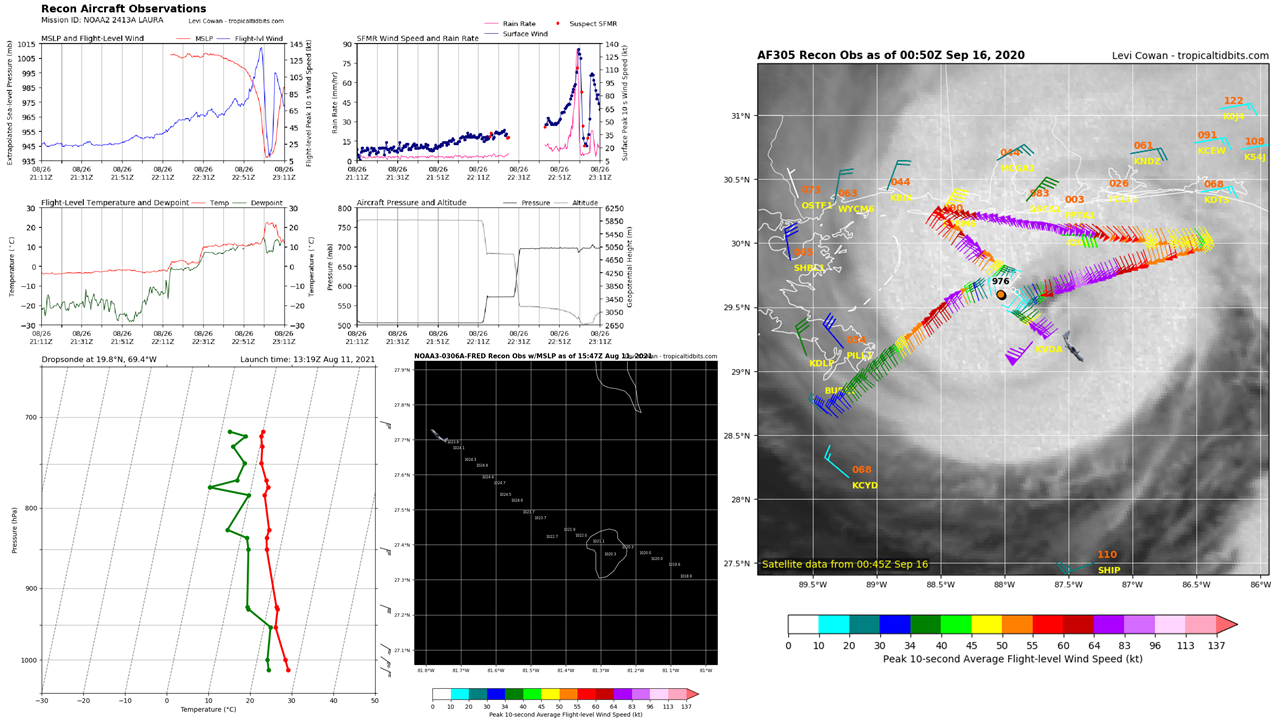
The past couple of hurricanes that have gone across Cuba have still weakened and don't always have enough "room" to re-intensify to full strength before hitting the Gulf states... i.e., not enough time to complete an ERC.
But agree that climate change has definitely intensified these storms to the point where there has been discussion about expanding the Saffir-Simpson scale to include a "Cat 6" category.
DemocracyForever
(464 posts)that I explained in my previous post. No offense but it's really not possible that you know more about this than my engineer father knew about this. It's nice to go to a website but my engineer father had actual personal experience.
BumRushDaShow
(174,540 posts)almost 10 years ago. 
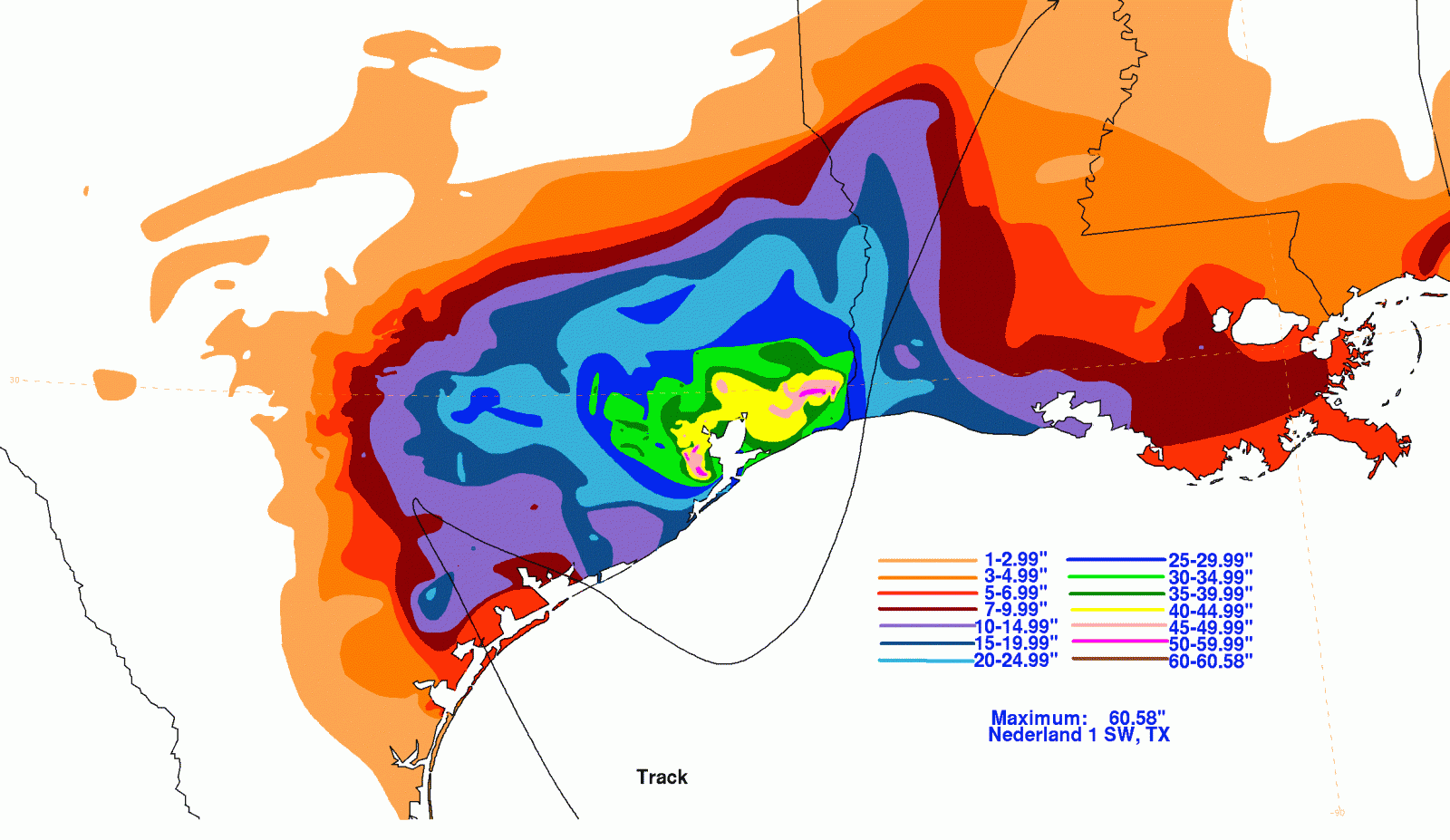
It's simple storm dynamics and atmospheric dyanmics. The storm gets cut off from it's steering flow and sits and spins. These storms "ride the jetstream" and if they somehow miss their "ride", then it can be devastating because they are now drifting. And if that happens when they are near a large body of water, it can just enhance it more because they get a moisture feed. You don't need to be in an aircraft or an engineer to know this.
You are making it more complex than it is. Maybe you need to do some more study yourself because you are obviously not understanding it yourself.
DemocracyForever
(464 posts)and it shows with your posts. This is not simply about atmiospherics. Hurricanes are clearly now behaving in much more dangerous ways because of our warming planet. The Houston hurricane along with Ashville are solid examples of this new and more dangerous behaviors. Maybe if you'd actually flown hurricane reconnaissance like my engineer'pilot father with 40 years of mechanical engineering and flying experience, you would better understand what's now happening. Please don't think because you read a website that you know more about this than my engineer/pilot father. You don't and you never will.
BumRushDaShow
(174,540 posts)They are their own separate fields. "Mechanical engineering" seems to have little to do with the actual "science" of hurricanes except maybe applicable to the instrumentation operation (or design/modification). I was in many classes with piles of engineers - chemical, mechanical, electrical, even some civil ones.
I literally almost majored in meteorology in college and got as far as freshman orientation to have to decide whether to go with that or the ACS Certified Chemist curriculum that I eventually would take, and picked chemistry because at the time, the job prospects for mets were low (this was before commercial outlets like TWC existed and Accuweather was still a youngish outfit, and where federal mets were loathe to retire to open a slot for new hires).
You have really gone off the deep end and I'm wondering what science courses you have taken yourself (it seems like little or none). You sound like a youngster too. You are repeating simplistic and narrow talking points that have little meaning to the field as a whole. 
DemocracyForever
(464 posts)You think that because you read a website that you know more than experts with decades of experience. It's clear that you don't. FYI, meteorologists have extensive weather training. My engineer/pilot father had extensive weather training as weather knowledge is critical for pilot survival. You obviously have no such weather training. My engineer father well understood that our warming planet is causing the jet steam to change and behave in very different ways than it did in the past. This is contributing to hurricanes behaving in very different ways and becoming much more damaging. You don't seem to understand that. You've also never actually flown hurricane reconnaissance like my engineer/pilot father so you have no idea. Since my engineer father knew exactly how every aviation and automotive fuel and oils were formulated, he was well aware of the greenhouse gases that are created when fossil fuel is burned and the fact that these greenhouse gases are poisoning our planet, significantly changing the weather patterns and threatening the survival of humanity.
One of many things that's wrong with our country is the disrespect for expertise by people with no such expertise. Again, you think that because you read a website, you're an expert. That's not how it works. Your disrespect for expertise you'll never have is offensive.
BumRushDaShow
(174,540 posts)Weather has been one of my hobbys for over 55 years, I expect long before you were born and WAY before there was any "world wide web" when there were things called "books" and "seminars" and whatnot. My college did have a mainframe that we connected to however (as one of the-then primary domains out there - a .edu, which joined the .gov, and .mil - before the internet was commercialized).
My dad was a COBOL programmer for the federal government from the mid-1950s to the mid-1970s.
I ask you again, what "science degree" do you have?
I am an ACS Certified Chemist.
That meant that I had to take a specific scientific curriculum, IN A SPECIFIC ORDER, and was given specific ACS-designed final exams that corresponded to achieving that certification. And my curriculum not only included chem classes like basic, organic, inorganic, analytical, and physical, but I also had to take a computer science course, take 3 semesters of Calculus and 3 semesters of Physics. This was on top of the regular "liberal arts" stuff like a couple semesters of a foreign language, writing, social sciences, and the humanities.
I guarantee I know far more about the "natural world" then you seem to be aware of.
Seriously - what degree do you have in any "science"? Instead of trolling on this subject, why not contribute something meaningful?
DemocracyForever
(464 posts)It was my engineer/'pilot father who taught me about the weather and the threat of human caused climate change. You once again ignore my engineer/pilot father's engineering and aviation expertise. All you're doing is reading off of a website or a book. You have no personal flying or engineering experience and it shows with your posts. You don't seem to understand the basic fact that our warming planet is disrupting the jet stream causing it to behave in very different ways. You don't understand another basic fact that the warming of our planet is causing the oceans to warm which is supercharging hurricanes and causing them to behave in much more catastrophic and deadly ways. I'm really tired of your disrespect for my father's engineering and aviation expertise that you'll never have. Your behavior is disrespectful and offensive and it needs to stop.
BumRushDaShow
(174,540 posts)Got it. I"ll take that to mean you have none.
Not one thing that I have posted ever denied anything about ocean warming nor the corresponding atmospheric warming that cannot be dismissed out of hand, which you continue to do due to a lack of a science background. The trends are clear with "warming" and the negative impacts of it, including the melting of the glaciers at the poles, and loss of permafrost in places like Alaska.
I regularly monitor SSTs off the nearby Jersey coast and post the periodic assessments from the various Global climatological entities.
Unfortunately it's difficult to have any kind of lucid scientific conversation with a non-scientist acting as a go-between to another scientist and your not understanding certain concepts presented to you that I actually posted and you repeated almost verbatim, but that you apparently claim wasn't understood. I do hope you continue to show interest in the subject though because the impacts are real and the severity of weather events have exploded in the past decade!!!
DemocracyForever
(464 posts)Where's your flying, weather forecast interpreting and engineering experience? You have none. Because you have none, you'll never know as much about this as my engineer/pilot father knew. You're the one who is the non expert. I'm telling you what my engineer/pilot father taught me. Again, you have no such expertise and it shows in your posts. I'm sick and tired of your disrespect for my engineer/pilot father's expertise that you'll clearly never have. I'm offended by your disrespect for my engineer/pilot father's expertise and I won't tolerate it. You're really naive if you think an anti climate change MAGA controlled NOAA is providing accurate information,
BumRushDaShow
(174,540 posts)NEWS FLASH - 'flying" is NOT a requirement for MOST of the occupations that deal with weather including meteorology, climatology, oceanography, hydrology, atmospheric sciences, and any number of other sub-fields. "Mechanical Engineering" is not a requirement for any of this.
It's pretty obvious that you have no background to understand the actual scientific dynamics behind what he "taught" you.
It's unfortunate that you continue the repetitive trolling instead of learning something, but I embrace the "each one teach one" method.
It's sad that you have no background in the federal workplace and civil service system and don't realize that the only "MAGats" in the current administration are those who were APPOINTED (and the appointees that those who were appointed brought in). The rest of who is there are regular people with scientific backgrounds. To tar and feather every employee in an entire agency shows your naivety. No one including ME has "disrespected" your "mechanical engineer father". At the beginning of this thread, I praised the hurricane hunters who are part of the crews who fly into those storms. You ignored that and have been intent on the talking points.
Now answer my question - what science degree do you possess? I expect none and it's really obvious.
DemocracyForever
(464 posts)For the record, you have no science degree. Again, my engineer/pilot father taught me about climate change causing the changing weather patterns. You have no such understanding of this fact. You again don't understand that our warming planet is causing the jet stream to behave in ways never seen before. This fact is the reason that Atlanta which never gets snow of this amount had 6 inches of snow earlier this year. You also clearly have no understanding that extensive knowledge of the weather is an absolute safety essential for pilots to stay safe and also too protect their passengers. In addition to flying hurricane reconnaissance which you've never done, my engineer/pilot father well understood that our warming planet was causing long established weather patterns to change. You have no understanding of this. You also have no understanding that warmer air holds more moisture which is resulting in bigger and more damaging storms. Again, you think because you can read a website and a book that makes you an expert. You could not be more wrong.
FYI, I have more than 20 years experience working on dem election campaigns at all levels. You clearly don't seem to understand how the MAGA appointees have poisoned every federal government department including NOAA. Are you not aware that the MAGAS have taken down all references to climate change at the NOAA website? This should be a clue to you that the information coming from NOAA is no longer reliable.
Again, I don't like and won't tolerate your disrespect for my engineer/pilot father's expertise. This is expertise that you'll never have. FYI, it's not possible that you know more about the weather and climate change than my engineer/pilot father knew. He was an expert while you're clearly not an expert. It's time for you to go back to your website and book reading and leave the real work to the experts who know way more about this than you ever will. I'm tired of your posts that do nothing but insult my engineer/pilot father's expertise. Your behavior is offensive.