General Discussion
Related: Editorials & Other Articles, Issue Forums, Alliance Forums, Region ForumsThey be-best-NOT take FDR off the dime permanently.
**********QUOTE*******
https://www.usmint.gov/news/media-kit/semiq-resources#accordion-f53ccdf1e0-item-585c99ab5e
This media kit includes resources about the Semiquincentennial (SemiQ) Program—a one-year-only, 250th anniversary celebration of our Nation’s founding.
To celebrate America's SemiQ in 2026, the Mint will be updating well-known American coinage, such as the circulating dime, nickel, and quarter, as well as the collectible penny, and half dollar. Other popular Mint products will feature special privy marks, dual dates, and design changes, as well.
Browse or use the navigation below to find high-resolution images, press releases, video and b-roll, social media tags, and contact information. ....
2. Which circulating coins will change in 2026?
To celebrate America's SemiQ in 2026, the Mint will be updating well-known American coinage, such as the circulating dime, whose design has not changed in 80 years. The circulating quarter will feature five new designs related to American history. These coins, as well as the circulating nickel, will have a “1776 ~ 2026” dual date.
5. What will happen to circulating coin designs after 2026?
In 2027, the dime will revert to the immediately previous design. The 2027 reverse designs for the quarter and half dollar will celebrate Youth and Paralympic Sports as part of a new four-year program authorized by the Public Law 116-330.
*********UNQUOTE**********
https://www.usmint.gov/news/media-kit/semiq-resources#accordion-f53ccdf1e0-item-585c99ab5e

 = new reply since forum marked as read
Highlight:
NoneDon't highlight anything
5 newestHighlight 5 most recent replies
= new reply since forum marked as read
Highlight:
NoneDon't highlight anything
5 newestHighlight 5 most recent replies

Dave Bowman
(6,636 posts)
Emile
(40,591 posts)
UTUSN
(76,896 posts)Emile
(40,591 posts)
Ilsa
(63,819 posts)He doesn't like disabled people and thinks all of them should be hidden from public view. Especially veterans. Imagine the image of amputees and wheelchair bound citizens on our coin! It might give him another stroke.

hunter
(40,367 posts)I don't know why we use inflation to cover up the misdeeds and missteps of those who regulate our economy. Historically we've swept a lot of shit under the rug and inflation is the stink of it.

Trailrider1951
(3,561 posts)Yeah, FDR was one of our greatest presidents, and I hate to see his likeness go. However, I do support the return to classic coin design. I've always admired the artwork that has gone into our coinage, with the Peace Dollar being my favorite:

This design reminds me of that coin, and I think it is just beautiful. But I do not like the reverse:

The eagle seems to have dropped the olive branch, which symbolizes peace. The arrows symbolize defence (war?). And I think that the "Liberty over Tyranny" is a bit much. JMHO. 
Emile
(40,591 posts)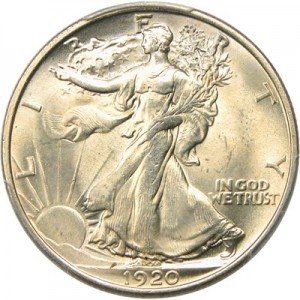
Trailrider1951
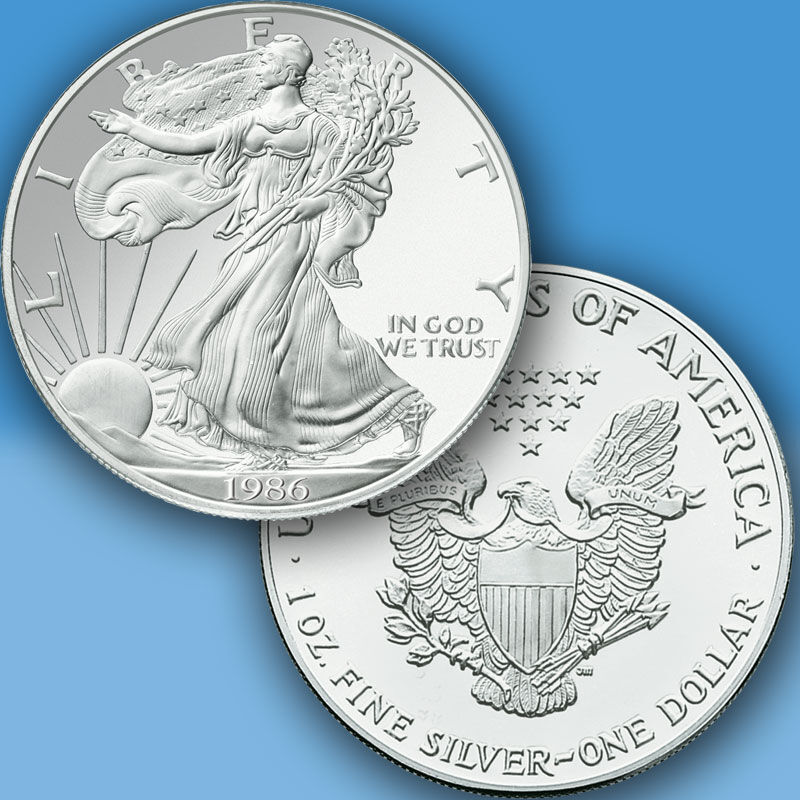
(3,561 posts)I'm glad they brought it back with the American Silver Eagle coin (1 oz. silver bullion).
Emile
(40,591 posts)Trailrider1951
(3,561 posts)Or are our paper dollars worth less today? Inquiring minds want to know.
Emile
(40,591 posts)I normally buy one whenever I go to Smith Coins https://www.smithscoins.com/ in Lafayette, Indiana.

Maru Kitteh
(31,245 posts)Gonna guess they gave “you-know-who” some options on the reverse. He’s blind and recently got himself in a lather over going back to Times New Roman font. It just looks like crap he would choose.

no_hypocrisy
(54,269 posts)and The New Deal.
I’m incensed.
Initech
(107,419 posts)
UTUSN
(76,896 posts)will revert to the immediately previous design" - have a vaguely ominous and threatening implication."
Kid Berwyn
(22,926 posts)
Asking for a famous couchhumper.

mahatmakanejeeves
(68,212 posts)Thu Jan 30, 2025: On this day, January 30, 1919, Fred Korematsu was born.
Link to tweet
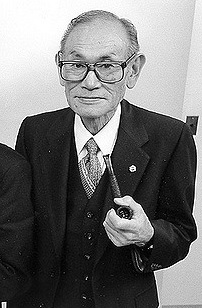
Born: January 30, 1919; Oakland, California, U.S.
Died: March 30, 2005 (aged 86); Marin County, California, U.S.
Resting place: 37°50'06"N 122°14'12"W
Monuments
Fred T. Korematsu Elementary School in Davis
Fred T. Korematsu Campus of San Leandro High School
Fred T. Korematsu Discovery Academy in Oakland
Fred T. Korematsu Middle School in El Cerrito
Awards: Presidential Medal of Freedom (1998)
Website: korematsuinstitute.org
Fred Toyosaburo Korematsu (January 30, 1919 – March 30, 2005) was an American civil rights activist who objected to the internment of Japanese Americans during World War II. Shortly after the Imperial Japanese Navy launched its attack on Pearl Harbor, President Franklin D. Roosevelt issued Executive Order 9066, which authorized the removal of individuals of Japanese ancestry living on the West Coast from their homes and their mandatory imprisonment in internment camps, but Korematsu instead challenged the orders and became a fugitive.
The legality of the internment order was upheld by the Supreme Court of the United States in Korematsu v. United States (1944). However, Korematsu's conviction for evading internment was overturned four decades later in US District Court, after the disclosure of new evidence challenging the necessity of the internment, evidence which had been withheld from the courts by the U.S. government during the war. Eventually, the Korematsu ruling itself was formally condemned seventy-four years later in Trump v. Hawaii, 585 U.S. ___ (2018).
To commemorate his journey as a civil rights activist posthumously, "Fred Korematsu Day of Civil Liberties and the Constitution" was observed for the first time on his 92nd birthday, January 30, 2011, by the state of California, the first such commemoration for an Asian American in the United States. In 2015, Virginia passed legislation to make it the second state to permanently recognize each January 30 as Fred Korematsu Day.
The Fred T. Korematsu Institute was founded in 2009 to carry on Korematsu's legacy as a civil rights advocate by educating and advocating for civil liberties for all communities.
{snip}
Biography
Youth
Fred Toyosaburo Korematsu was born in Oakland, California, on January 30, 1919, the third of four sons to Japanese parents Kakusaburo Korematsu and Kotsui Aoki, who immigrated to the United States in 1905. Korematsu resided continuously in Oakland from his birth until the time of his arrest. He attended public schools, participated in the Castlemont High School (Oakland, California) tennis and swim teams, and worked in his family's flower nursery in nearby San Leandro, California. He encountered racism in high school when a U.S. Army recruiting officer was handing out recruiting flyers to Korematsu's non-Japanese friends. The officer told Korematsu, "We have orders not to accept you." Even his girlfriend Ida Boitano's Italian parents felt that people of Japanese descent were inferior and unfit to mix with white people.
World War II
When called for military duty under the Selective Training and Service Act of 1940, Korematsu was formally rejected by the U.S. Navy due to stomach ulcers, but it is believed that he was actually rejected on the basis of his Japanese descent. Instead, he trained to become a welder in order to contribute his services to the defense effort. First, he worked as a welder at a shipyard. He went in one day to find his timecard missing; his coworkers hastily explained to him that he was Japanese so therefore he was not allowed to work there. He then found a new job, but was fired after a week when his supervisor returned from an extended vacation to find him working there. Because of his Japanese descent, Korematsu lost all employment completely following the attack on Pearl Harbor.
On March 27, 1942, General John L. DeWitt, commander of the Western Defense Area, prohibited Japanese Americans from leaving the limits of Military Area No. 1, in preparation for their eventual evacuation to internment camps. Korematsu underwent plastic surgery on his eyelids in an unsuccessful attempt to pass as a Caucasian, changed his name to Clyde Sarah and claimed to be of Spanish and Hawaiian heritage.
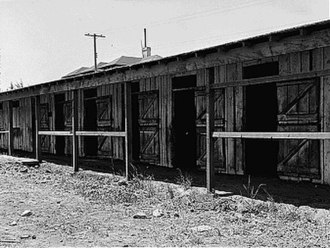
Former horse stalls converted for temporary occupation by Japanese American
internees at Tanforan Assembly Center, San Bruno, California, 1942
When on May 3, 1942, General DeWitt ordered Japanese Americans to report on May 9 to Assembly Centers as a prelude to being removed to the internment camps, Korematsu refused and went into hiding in the Oakland area. He was arrested on a street corner in San Leandro on May 30, 1942, and held at a jail in San Francisco. Shortly after Korematsu's arrest, Ernest Besig, the director of the American Civil Liberties Union in northern California, asked him whether he would be willing to use his case to test the legality of the Japanese American internment. Korematsu agreed, and was assigned civil rights attorney Wayne M. Collins. But the national ACLU in fact argued for Besig, its own district director, not to fight Korematsu’s case, since many high-ranking members of the ACLU were close to President Roosevelt and the ACLU didn’t want to be viewed negatively during a time of war. Besig decided to take Korematsu's case despite this.
Korematsu felt that "people should have a fair trial and a chance to defend their loyalty at court in a democratic way, because in this situation, people were placed in imprisonment without any fair trial". On June 12, 1942, Korematsu had his trial date and was given $5,000 bail (equivalent to $78,238.29 in 2019). After Korematsu's arraignment on June 18, 1942, Besig posted bail and he and Korematsu attempted to leave. When met by military police, Besig told Korematsu to go with them. The military police took Korematsu to the Presidio. Korematsu was tried and convicted in federal court on September 8, 1942, for a violation of Public Law No. 503, which criminalized the violations of military orders issued under the authority of Executive Order 9066, and was placed on five years' probation. He was taken from the courtroom and returned to the Tanforan Assembly Center, and thereafter he and his family were placed in the Central Utah War Relocation Center in Topaz, Utah. As an unskilled laborer, he was eligible to receive only $12 per month (equivalent to $187.77 in 2019) for working eight-hour days at the camp. He was placed in a horse stall with a single light bulb, and later said "jail was better than this".
{snip}
Legacy
{snip}
• On September 23, 2010, Governor Arnold Schwarzenegger of California signed into law a bill that designates January 30 of each year as the Fred Korematsu Day of Civil Liberties and the Constitution, a first for an Asian American in the United States. It was observed for the first time on January 30, 2011. The main celebration of the California state was held at the Wheeler Auditorium on the University of California, Berkeley campus, sponsored by the Korematsu Institute, a non-profit program co-founded by Korematsu's daughter Karen Korematsu to advance racial equity, social justice, and human rights as well as the Asian Law Caucus, a San Francisco-based civil rights organization. The event included presentations by the Rev. Jesse Jackson and a screening of the Emmy Award-winning film Of Civil Wrongs and Rights: The Fred Korematsu Story.
• In 2015, the Commonwealth of Virginia established January 30 as "Fred Korematsu Day of Civil Liberties and the Constitution" beginning in 2016.
{snip}
Mon Feb 19, 2024: On this day, February 19, 1976, President Gerald R. Ford signed a proclamation formally terminating EO 9066.
Kid Berwyn
(22,926 posts)As Assistant Secretary of War. Odd how he later became High Commissioner for Germany after the NAZI surrender and forgave many of the worst (the wealthiest, "coincidentally," Allen Dulles would say) German war criminals.
The American who let the Nazis rebuild Germany
https://thecritic.co.uk/issues/november-2021/the-american-who-let-the-nazis-rebuild-germany/
CIA and NAZI War Criminals
https://nsarchive2.gwu.edu/NSAEBB/NSAEBB146/index.htm

The Real McCloy
THE CHAIRMAN: JOHN J. McCLOY; The Making of the American Establishment,
By Kai Bird (Simon & Schuster: $30; 800 pp.)
By ROBERT SHERRILL
APRIL 19, 1992, The Los Angeles Times
EXCERPT...
When McCloy took over as high commissioner of defeated Germany, he talked a tough line about crushing the many still- active Nazis. But he promptly turned to mush, permitting Chancellor Konrad Adenauer to fill his cabinet with notorious antisemites and Nazi war criminals (some of whom became McCloy’s personal friends). McCloy also vastly expanded the shameful programs begun before he got to Germany, of letting some of the worst war criminals off the hook.
He commuted two-thirds of the death sentences of mass murderers (such as the SS officer who personally executed 1,500 Jews) and radically reduced the prison sentences of doctors who had conducted experiments on death-camp inmates, of high-ranking Nazi Judges who had administered Gestapo justice, and of industrialists who had built the Nazi war machine.
McCloy freed some immediately, including Alfred Krupp, whose munitions factories had worked thousands of slave laborers to death. Krupp’s original sentence had included loss of all property; McCloy canceled that punishment and within a few years Krupp was again one of the richest industrialists in the world. Obviously McCloy’s obsequiousness toward money and power made him the wrong man to reform Nazi Germany. “Though he could understand the special culpability of the ‘big Nazis,’ ” Bird writes, “when it came to a wealthy and politically well-connected man like Krupp, he suspended his good judgment.”
As high commissioner, McCloy dabbled disastrously in the intelligence business, setting up a network of agents in Germany that included the likes of Klaus Barbie, who had shipped 78,000 French Jews to the gas chambers, and Gen. Reinhard Gehlen, who had been responsible for some of the “grisliest mass killings on the Eastern Front.” Not surprisingly, many of the intelligence operations carried out under McCloy were, says Bird, “fiascos.”
CONTINUES...
https://www.latimes.com/archives/la-xpm-1992-04-19-bk-588-story.html
Mr. McCloy was joined by another “Mr. Establishment” type with extensive ties to wealthy NAZI industrialists and anti-communist NAZI spy rings, former CIA Director Allen Dulles, in service on the Warren Commission. Coincidentally. Their colleagues kept faith in the Almighty Dollar.
CIA Chief Bush Suppresses the News
By Robert Gardner
FAIR Exclusive
May/June 1999
Documents obtained by FAIR, released through the Freedom of Information Act (FOIA), show that George Bush, as head of the CIA in 1976, tried to bottle up a news story that exposed the apparent duplicity of another former CIA chief, Richard Helms.
The story, broken on Oct. 1, 1976, by David Martin (now CBS Pentagon correspondent, then with Associated Press), revealed that Helms had given misleading testimony to the Warren Commission investigating the assassination of John Kennedy. Helms testified that the CIA had not "even contemplated" making contact with Lee Harvey Oswald, the accused assassin. Through the FOIA, Martin obtained CIA memos showing that in 1960 the agency "showed intelligence interest" in Oswald and "discussed...the laying on of interviews" with him.
When Bush saw the AP story in the Washington Star, he asked for an internal CIA review to see if the story was true (it was) and if it would "cause problems for Helms." (Helms had lied to a Senate committee about the CIA's role in subverting Chilean democracy and would later be convicted of contempt of Congress.)
After investigating, Bush assistant Seymour Bolten reported back that the exposure of Helms' false testimony to the Warren Commission would probably cause Helms "some anxious moments," though not "any additional legal problems." But Bush was assured that a "slightly better" story had resulted from an Agency phone call to AP protesting that Martin's story was "sloppy." Additionally, Bush was told that an unnamed journalist had "advised his editors . . . not to run the AP story."
Bolten complained to Bush: "This is another example where material provided to the press and public in response to an FOIA request is exploited mischievously and in distorted form to make the headlines." One might more accurately describe it as an occasion where George Bush's CIA pressured one news outlet to back away from an accurate story while using an asset in the press corps to suppress it in another.
http://www.fair.org/index.php?page=1491
Of course, few today remember his role on the Warren Commission, where he and Dulles made Lee Harvey Oswald the fall guy. Thank goodness for DU.